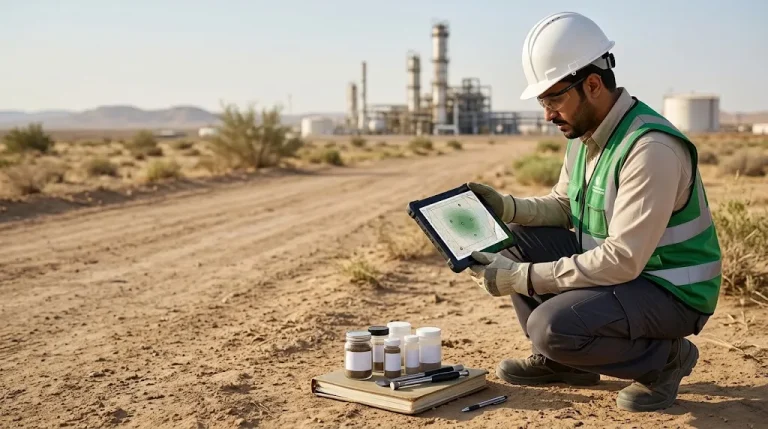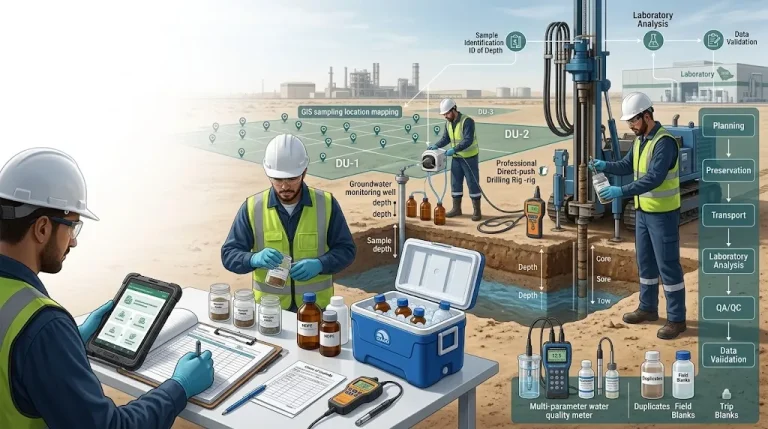

When 30 cm of fuel appears inside a monitoring well at a gas station or petroleum products depot, it is easy to assume that the fuel layer underground is equal to 30 cm. However, this conclusion is inaccurate. The reading inside the well represents the well's response to the petroleum product and does not directly measure the thickness of a homogeneous layer or the volume of fuel within the surrounding soil.
Direct answer: The product thickness measured inside the well refers to the Apparent LNAPL thickness, which is important monitoring data, but it does not equate to the volume, mass, mobility, or recoverability of the contamination. A correct assessment correlates this reading with soil properties, groundwater levels, product distribution, the dissolved phase, vapors, and potential receptors within a conceptual site model.
What is LNAPL?
LNAPL is an abbreviation for Light Non-Aqueous Phase Liquid, which is an organic liquid that is sparingly soluble in water and typically has a lower density than water. It can exist at fuel-impacted sites as a separate liquid phase within the pore spaces of the soil and subsurface layers.
Common examples include gasoline, diesel, kerosene, jet fuel, and certain oils and petroleum products. The phrase 'LNAPL floats on groundwater' is useful as a starting point, but it does not explain the actual behavior within heterogeneous soil, micro-pores, and fluctuating water tables.
What is meant by the apparent thickness of LNAPL inside a well?
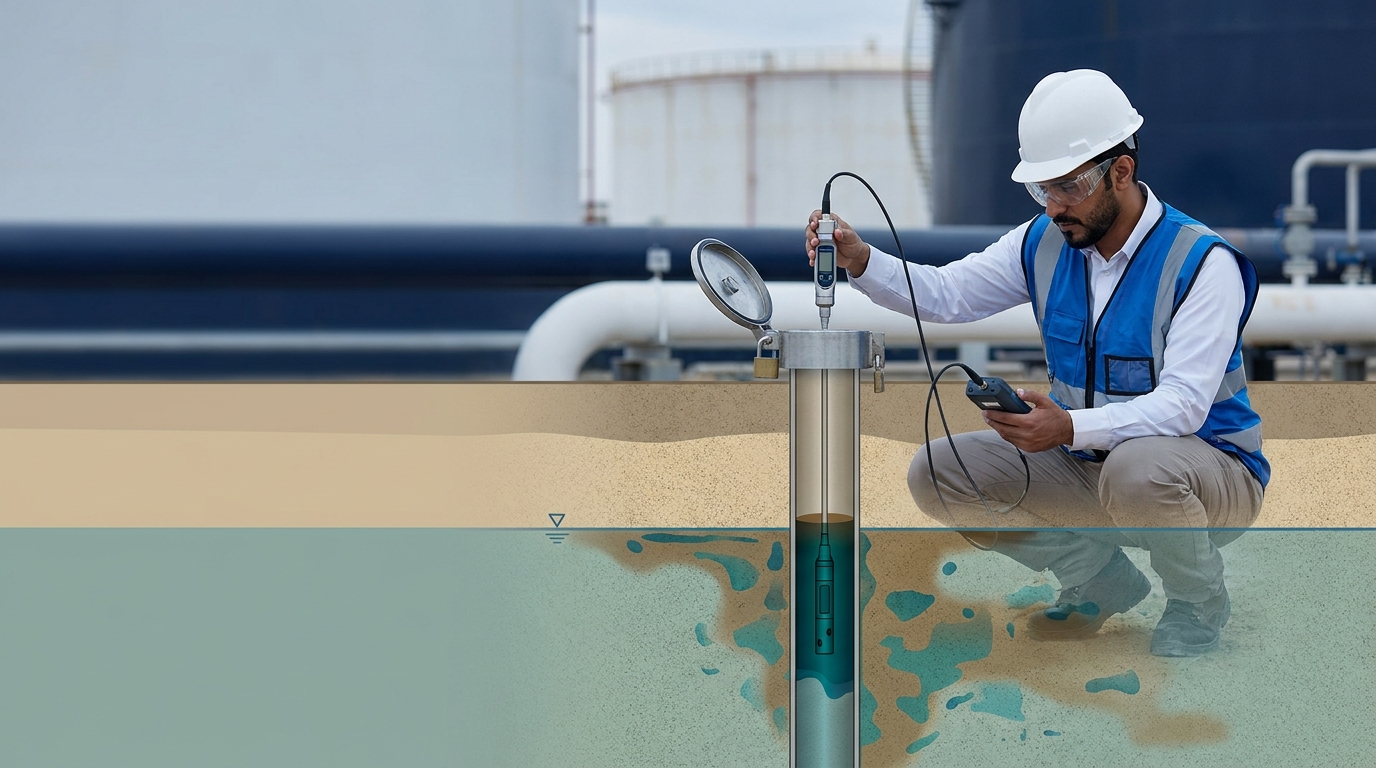
When using an oil-water interface probe inside a well, the distance between the product surface and the product-water interface is recorded. This reading is called the Apparent LNAPL Thickness , or apparent thickness.
The well is a relatively open space, while the surrounding soil is a porous medium containing varying proportions of water, air, and petroleum product. Therefore, the mobile portion of the product may accumulate inside the well in a manner that differs from its actual distribution in the pores.
Basic rule: LNAPL thickness inside a well does not equal its thickness in the formation, and there is no constant conversion factor to translate the well reading into underground thickness or volume.
Why does the well reading differ from the fuel distribution in the soil?
The distribution of LNAPL in the subsurface is influenced by interrelated factors, including pore size and distribution, permeability, capillary forces, product properties such as density and viscosity, degree of saturation, groundwater table fluctuations, and the stratigraphic sequence.
For this reason, a distinct product column might appear within a monitoring well, while the fuel outside the well is distributed within the pores at different depths and saturation levels, rather than as a continuous horizontal 'lake' on top of the groundwater.
Why is the 'floating fuel layer' model insufficient?
The simplified visualization treats petroleum product as a flat layer floating on top of water. Technical assessment, however, treats it as a multi-phase system within a porous medium: water, air, and LNAPL, whose ratios change both vertically and horizontally. There may be areas with high saturation near the source, and others containing residual amounts trapped in the soil.
This difference affects the estimation of the quantity, the understanding of movement, the selection of remediation methods, and the interpretation of monitoring well results.
In what forms can petroleum contamination exist underground?
A petroleum spill may not remain in one medium; instead, it can be distributed in more than one phase at the same time:
- Separate LNAPL: Petroleum product existing as a separate liquid within the pores.
- Adsorbed phase on soil: Compounds bound to soil particles or organic matter.
- Dissolved phase: A portion of the compounds dissolves into the groundwater, which may result in a dissolved contamination plume.
- Vapor phase: Some volatile compounds may migrate into soil gases, requiring an evaluation of the vapor pathway when site conditions are appropriate.
Therefore, measuring free product within the well alone is not sufficient; a site may be affected in the soil, groundwater, or vapors even if no free fuel appears in a specific well.
The absence of LNAPL in a well does not mean there is no petroleum impact
A portion of the product may remain trapped within the pores due to capillary forces in the form of Residual LNAPL, which is residual product that does not flow easily into the well under current conditions. Additionally, the rise and fall of the water table over time may lead to the redistribution of a historical product footprint across a vertical range, commonly known as the smear zone.
Therefore, the absence of free product does not rule out the presence of impacted soil, dissolved compounds in groundwater, soil vapors, or a residual source that requires more precise characterization.
What is the difference between Mobile and Migrating LNAPL?
Mobile LNAPL is the product capable of moving locally within the formation or toward a monitoring well. On the other hand, Migrating LNAPL refers to the actual advancement or expansion of the LNAPL body boundaries across the site.
The appearance of product in a well may prove that it can enter that well, but it does not by itself prove that the contamination plume is advancing, nor does it define the quantity of product in the subsurface or the level of risk to receptors.
Can fuel volume be estimated from thickness within wells?
It is not accurate to use a simple equation like: area of the plume × fuel thickness in the well. The volume of the soil is not entirely void space, LNAPL does not occupy the entire pore volume, and saturation and distribution vary between layers and sites.
Any estimate of volume or mass, when needed, must clarify the methodology, assumptions, data density, and uncertainty, and should be based on porosity, saturation degree, vertical and horizontal distribution, stratification, and product properties, rather than well thickness alone.
What is LNAPL Transmissivity and why does it matter?
LNAPL Transmissivity is an indicator of the formation's ability in a given area to transmit petroleum product toward a well under prevailing hydraulic conditions. Therefore, it is more closely linked to evaluating mobility and recoverability than apparent thickness alone.
A large thickness may appear in a well with a low capacity for product recharge after removal, while a smaller thickness may appear in another well with a faster response and higher transmissivity. Thus, thickness describes an observation inside the well, while transmissivity describes flow behavior in the formation.
How does a Baildown test help in understanding?
In a Baildown test, a portion of the product is removed from the well, and its return is monitored over time, along with water levels and the properties of the well and formation. When properly performed and interpreted, response data can help in understanding transport behavior and recoverability.
However, the result does not depend on the rate of return alone; its interpretation is affected by the well screen interval, layer properties, water table fluctuations, product characteristics, and measurement quality.
Changes in the groundwater level may alter the reading
Water table fluctuations can alter the location and distribution of LNAPL in the soil; consequently, the apparent thickness within a well may change between monitoring rounds without necessarily implying a similar change in the total product mass.
Therefore, product thickness must be interpreted in conjunction with groundwater levels, measurement dates, recent recovery activities, and results from other wells. It is useful Environmental monitoring reports to track trends in readings and results over time rather than relying on a single reading.
How is monitoring designed at a fuel-impacted site?
Monitoring begins by defining site questions: Where is the source? Which strata are impacted? What is the groundwater flow direction? Are dissolved phases or vapors present? And which receptors might be affected? These answers are then translated into appropriate well locations, depths, screen intervals, and analyses.
Wells should not be distributed solely based on property boundaries or a regular grid pattern. Good design is linked to the site conceptual model, geology, hydrogeology, material properties, available data, and data gaps.
Indicators that should not be evaluated in isolation
The evaluation of LNAPL site performance becomes more robust when linking the following indicators together:
- Apparent thickness within wells.
- Groundwater levels, flow direction, and temporal changes.
- LNAPL transmissivity and recovery data when available.
- Horizontal and vertical extent of the impacted zone.
- Groundwater analytical results for potential contaminants such as TPH or BTEX, depending on site history.
- Soil gas or vapor pathway data, where applicable.
- Status of receptors and site management objectives.
For instance, thickness may decrease in a source well while concentrations of dissolved components increase in a downgradient well. Similarly, thickness may remain stable while the recovery rate decreases. None of these indicators alone is sufficient to conclude whether the site is improving or deteriorating.
Common errors when evaluating LNAPL at fuel sites
- Equating product thickness within a well to its thickness in the soil.
- Calculating volume by multiplying the area of the plume by the thickness measured in monitoring wells.
- Considering the absence of free product as evidence that the site is free of petroleum impact.
- تحديد طريقة الاسترداد قبل فهم التوزيع والحركة وقابلية النقل.
- تقييم السماكة بمعزل عن منسوب المياه الجوفية والطور المذاب والأبخرة.
- اعتبار Mobile LNAPL دليلًا تلقائيًا على أن النطاق يتوسع.
- الاعتماد على كمية المنتج المستردة وحدها كمؤشر للنجاح.
- عدم تحديث النموذج التصوري بعد كل جولة بيانات جديدة.
ما الهدف من المعالجة أو الاسترداد؟
الهدف ليس دائمًا إزالة أكبر عدد من اللترات. قد يكون الهدف السيطرة على هجرة المنتج، أو خفض تغذية الطور المذاب، أو حماية مستقبل مائي، أو إدارة مسار أبخرة، أو دعم إعادة تأهيل الموقع واستخدامه بأمان. لذلك يجب أن يسبق اختيار التقنية فهم الموقع وتحديد هدف قابل للقياس.
وتساعد Environmental consulting for projects في تحويل بيانات الموقع إلى نطاق دراسة أو برنامج رصد أو مسار فني متناسب مع احتياجات المشروع، دون افتراض أن طريقة واحدة تصلح لكل المواقع.
أسئلة شائعة عن LNAPL
هل الديزل والبنزين من LNAPL؟
نعم، يمكن للديزل والبنزين وعدد من المنتجات البترولية أن تتصرف كـLNAPL عند إطلاقها في باطن الأرض. وقد ينتقل جزء من مكوناتها أيضًا إلى المياه الجوفية أو غازات التربة.
هل 50 سم من الوقود داخل البئر تعني 50 سم داخل التربة؟
لا. هذه سماكة ظاهرية داخل البئر، وتتأثر بخصائص الوسط المسامي والقوى الشعرية والمنتج ومنسوب المياه الجوفية.
هل البئر ذو السماكة الأكبر هو أفضل بئر للاسترداد؟
ليس بالضرورة. يلزم تقييم قابلية النقل، وسرعة إعادة دخول المنتج، وتصميم البئر، وخصائص التكوين، وأهداف العمل قبل اتخاذ قرار الاسترداد.
هل إزالة المنتج الحر من البئر تعني أن الموقع أصبح نظيفًا؟
لا. قد يبقى منتج متبقٍ داخل التربة أو أثر مذاب في المياه الجوفية أو غازات تربة. لذلك يجب تقييم جميع مسارات التأثير المناسبة للموقع.
هل يمكن الاعتماد على جولة قياس واحدة؟
الجولة الواحدة تقدم لقطة زمنية، لكنها لا تشرح عادة الاستقرار أو الاتجاه أو التغير مع منسوب المياه. القيمة الأكبر تأتي من ربط القياسات المتقاربة زمنيًا بنتائج متتابعة ونموذج موقع محدث.
How does Al-Bad' Al-Bee'i help?
The Albuad Environmental Company supports the review of potential release history, development of the site conceptual model, analysis of well data, apparent thickness, and elevations, identification of data gaps, correlation of soil, groundwater, and soil gas results where applicable, and support for characterization scopes, monitoring, and reporting. Excavation, testing, and field remediation works are defined according to the project scope, specialized entities, permits, and applicable requirements.
To understand the fundamentals of assessing affected sites before designing a detailed program, see Environmental Assessment and Review Studies Service Or Contact the Albuad Environmental Company team via WhatsApp to discuss site data and the appropriate scope of work.
Conclusion
Reading the apparent thickness of LNAPL inside a well is important, but it is not a direct measurement of the fuel volume or thickness in the soil, its recoverability, or the degree of risk. Professional interpretation integrates the thickness with geology, water table, distribution, transmissivity, recovery data, dissolved phase, and vapors, as well as receptors. In this way, the measurement transforms from a single number into a technical decision based on a realistic understanding of the site.
The content was reviewed by a team of environmental experts.
Environmental content at Albuad Environmental Company is prepared and reviewed by a team of specialists in environmental studies, environmental impact assessment, environmental compliance, and environmental monitoring.
Meet the expert team