 966535733690 +


What Are the Challenges in Preparing Environmental Reports for Industrial Projects?

In industrial projects, environmental reports are not prepared merely to satisfy a regulatory authority or to complete a licensing file. An environmental report represents the facility’s voice before regulators and serves as documented evidence of how the plant operates, how it impacts the environment, and how it manages risks. A minor error in a figure, an undocumented measurement, or an inaccurate interpretation can lead to rejection or suspension of the report—or even open the door to violations that were not anticipated. This is where the sensitivity of preparing environmental reports for industrial projects lies: it is not a purely administrative task, but a complex process involving data, operations, regulations, and accredited entities. In this article, we delve into the real challenges faced by factories and present practical solutions that turn the report into a tool for compliance and protection, rather than a source of concern.
Table of Contents:
- Why are environmental reports for industrial projects more complex?
- Data and measurement challenges: emissions, effluent, noise, and waste
- Operational challenges: fluctuating production loads and variable results
- Compliance challenges, regulatory limits, and how to interpret violations
- Managing accredited entities and chains of custody
- Practical solutions: documentation systems, monitoring schedules, and internal review prior to approval
Why are environmental reports for industrial projects more complex?
Industrial projects differ fundamentally from others in terms of scale, operational nature, and types of environmental outputs. For this reason, preparing environmental reports for industrial projects is more complex than for service or construction activities. Key reasons include:
- Multiple sources of environmental impact within the same facility
- Continuous operation (24/7) in some sectors
- Variability in production loads over time
- Diverse emissions and wastes (air, liquid, solid)
- Strict and precise regulatory thresholds linked to the report
An industrial environmental report does not reflect a single day; it represents cumulative performance over months or even years. Any flaw in data collection or interpretation can present an inaccurate picture of the facility’s performance. This highlights the critical role of technical and regulatory expertise— a gap addressed by specialized firms through supporting factories in building an integrated reporting system, not merely producing an annual file.
Contact us on WhatsApp now to assess your project and prepare a draft monitoring schedule prior to approval.
Data and measurement challenges: emissions, effluent, noise, and waste
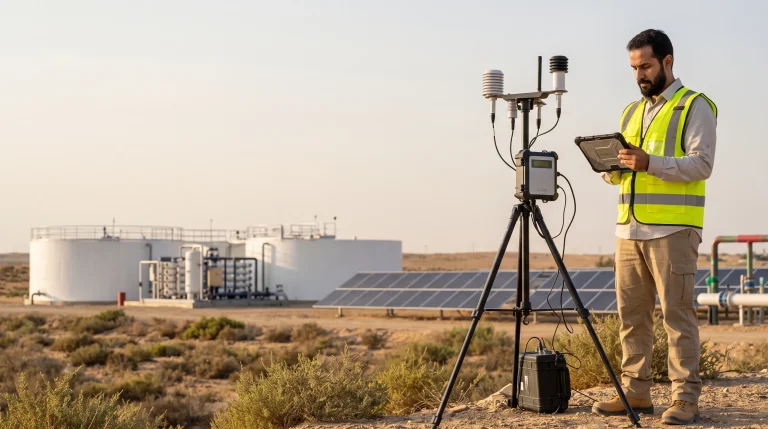
The greatest challenge in preparing environmental reports for industrial projects is data handling. A robust environmental report relies on data that are accurate, representative of actual conditions, and traceable and verifiable.
First: Emissions Measurements
Including stack emissions, gases, and particulate matter. Challenges include:
- Variation in results depending on operating conditions
- Impact of production loads on emission concentrations
- The requirement to use accredited laboratories
Second: Industrial Effluent
Assessing effluent quality and quantity requires:
- Representative sampling points
- Appropriate temporal frequency
- Clear understanding of regulatory discharge limits
Third: Noise
Industrial noise levels are influenced by:
- The number of operating machines
- Measurement location
- Measurement timing (day/night)
Fourth: Waste
Waste-related challenges include:
- Distinguishing between hazardous and non-hazardous waste
- Accurate documentation of quantities
- Tracking transport and disposal pathways
Any deficiency in these data can result in report rejection or requests for re-measurement. Therefore, successful environmental reporting for industrial projects depends on a structured monitoring system—not on sporadic or ad hoc measurements.
Operational challenges: fluctuating production loads and variable results
One of the most realistic challenges faced by industrial facilities is that operations are not constant. Production levels may increase or decrease depending on demand, maintenance schedules, or raw material availability. This variability is directly reflected in environmental results. When preparing environmental reports for industrial projects, the following issues commonly arise:
- Elevated measurement results during peak production periods
- Lower results during partial shutdowns
- Difficulty in selecting a fair representation of environmental performance
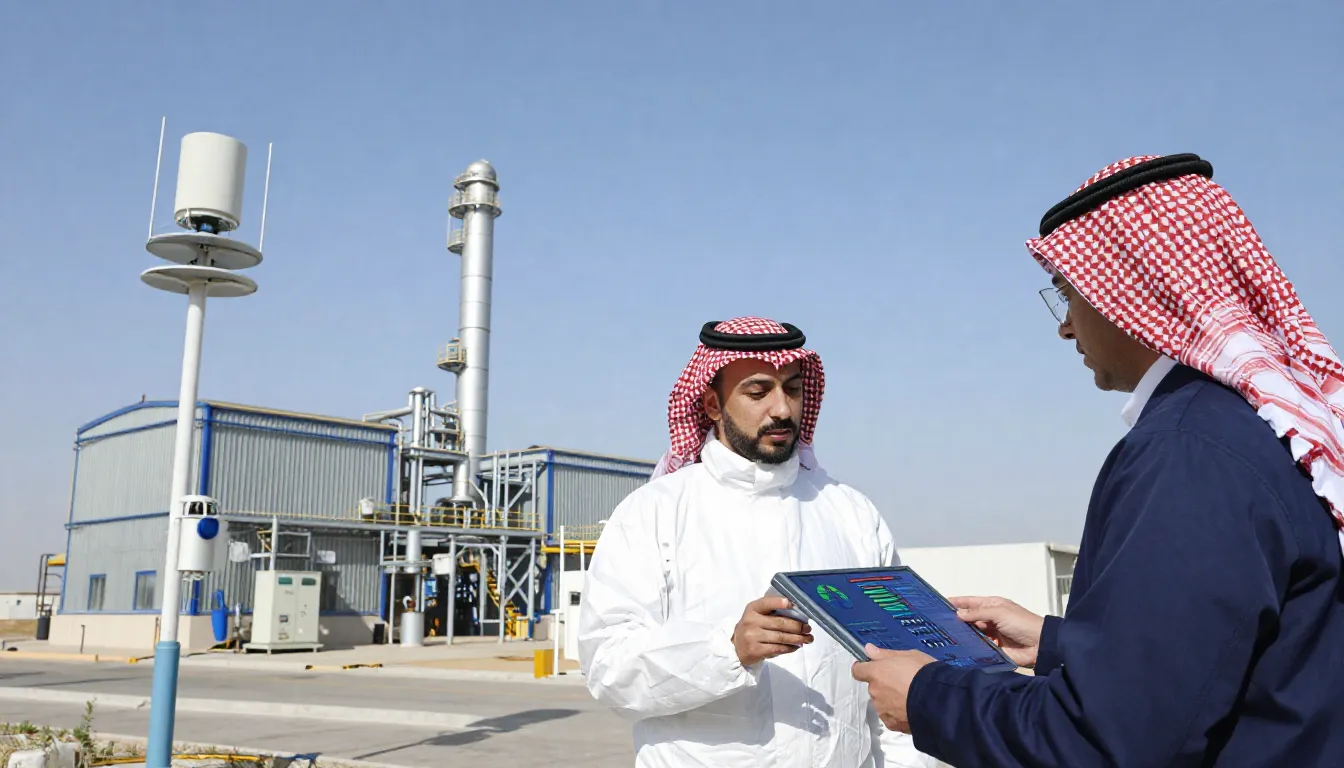
Regulatory authorities do not assess figures in isolation; they assess them within context. This is where technical interpretation within the report becomes essential. A strong environmental report does not merely present results—it explains:
- Operating conditions at the time of measurement
- The reasons behind result variability
- The control measures in place
This level of analysis requires deep technical expertise, which specialized firms provide by linking environmental data to operational context, delivering a fair and accurate picture of the facility’s performance.
Compliance challenges, regulatory limits, and how to interpret violations
Compliance with regulatory limits lies at the core of preparing environmental reports for industrial projects. However, the challenge is not limited to measurement alone—it extends to result interpretation. Key challenges include:
- Variation in limits based on activity type
- Multiple limits for the same pollutant
- Difficulty interpreting temporary exceedances
If a measured value exceeds a regulatory threshold, this does not necessarily indicate failure of the facility. However:
- Ignoring an exceedance is a serious error
- Concealing information exposes the facility to greater risk
A professional environmental report addresses exceedances by:
- Clearly documenting the exceedance
- Explaining its technical causes
- Presenting corrective actions
- Defining a plan to prevent recurrence
This approach demonstrates transparency and accountability and enhances regulatory confidence in the facility.
Managing accredited entities and chains of custody
One of the most sensitive aspects of preparing environmental reports for industrial projects is managing accredited entities and the chain of custody. Every measurement or sample must be:
- Collected correctly
- Preserved according to requirements
- Transported with a clear and documented chain of custody
Common challenges include:
- Missing or incomplete chain-of-custody documents
- Unclear sampling time or location
- Discrepancies between report data and laboratory reports
Any failure in this chain may result in rejection of the entire report—even if the results themselves are excellent. For this reason, documentation management is just as critical as the measurements themselves.
Practical solutions: documentation systems, monitoring schedules, and internal review prior to approval
Despite these challenges, preparing environmental reports for industrial projects can become a structured and efficient process when practical solutions are applied:
1. Centralized Documentation System
This system includes:
- Archiving all reports and measurements
- Storing official correspondence
- Standardizing forms and records
2. Clear Environmental Monitoring Schedule
A monitoring schedule defines:
- What is measured
- When measurements are taken
- The responsible entity
3. Internal Review Prior to Submission
A critical step to:
- Identify errors before submission
- Improve technical wording
- Ensure consistency across data
Specialized environmental consultancies provide these solutions within an integrated framework that reduces the burden on operational teams and ensures robust, compliant environmental reports.
Frequently Asked Questions
What is the most common reason for rejecting or suspending an industrial environmental report?
The most frequent reasons are incomplete documentation, the use of non-accredited measurements, or failure to properly interpret regulatory exceedances.
Can internal measurements be used instead of accredited entities?
In some cases, they can be used for internal monitoring purposes; however, official reports usually require measurements from accredited entities.
How are regulatory exceedances handled within the report?
Through full documentation, clear explanation of the causes, and presentation of corrective actions and prevention plans.
What is the optimal frequency for environmental monitoring in industrial facilities?
It depends on the type of activity, but periodic monitoring (monthly or quarterly) provides a more accurate picture than relying solely on annual monitoring.
Preparing environmental reports for industrial projects is not merely a regulatory obligation; it is a strategic process that protects the facility, supports its sustainability, and strengthens regulatory trust. The challenges are real, but they are manageable when a clear system and specialized expertise are in place.
If you are seeking accurate, compliant environmental reports that can withstand any review or inspection, provides you with provides the technical, organizational, and advisory support needed to transform environmental reporting from a heavy burden into a tool for strength and compliance.
Start now, and let Al-Buad Environmental experts help you build reliable and sustainable industrial environmental reports.
The content was reviewed by a team of environmental experts.
Environmental content at Al-Ba’ad Al-Bia’i Environmental Consulting Company is prepared and reviewed by a team of specialists in environmental studies, environmental impact assessment, environmental compliance, and environmental monitoring.
Meet the expert team