 966535733690 +


Environmental Fines and Violations: How Can You Protect Your Business from Financial Risks?

Many business owners believe that environmental violations are rare or only associated with large factories, but the reality is quite different. In recent years, environmental violations and fines have become one of the most common factors that drain the budgets of businesses—small enterprises even before large ones. Sometimes the violation occurs due to a simple procedure that was overlooked, a record that was not updated, or an expansion that was carried out quickly without reviewing environmental requirements.
The real problem is not only the fine itself, but also its extended consequences, such as suspension of operations, reputational damage, or being required to implement costly corrective measures that could have been easily avoided. In this article, we will take you on a practical journey to understand the causes of violations, early warning signals, and how to protect your business from financial risks before they occur.
Table of Contents:
- Why do environmental violations repeatedly occur in commercial and industrial activities?
- The most common sources of violations: waste, emissions, discharge, and noise
- Early warning signs inside a facility before a violation occurs
- Internal compliance policy: responsibilities, records, and periodic reviews
- Rapid corrective action plan when non-compliance is detected
- When do you need consulting support to assess compliance gaps?
Why do environmental violations repeatedly occur in commercial and industrial activities?
The recurrence of violations is not necessarily intentional negligence; rather, it is often the result of a gap between daily operations and regulatory requirements. Many facilities operate with high production efficiency but lack a clear environmental compliance system, making them vulnerable to environmental violations and fines without even realizing it.
Among the most prominent causes of recurring violations are:
- Relying on outdated practices that are no longer accepted by regulators.
- Changes in laws and regulations without corresponding internal updates.
- The absence of a clearly designated environmental officer within the facility.
- Focusing on production more than environmental risk management.
- Assuming that the absence of inspection means the absence of a problem.
Today’s regulatory environment does not rely solely on inspections; it also depends on tracking systems, reporting mechanisms, and smart monitoring tools. This makes proactive compliance a necessity rather than an option.
Get an instant assessment of environmental violation risks in your facility via WhatsApp.
The most common sources of violations: waste, emissions, discharge, and noise
When analyzing most recorded environmental violations and fines, it becomes clear that they are concentrated in four main sources that repeatedly occur across different activities:
First: Waste Management
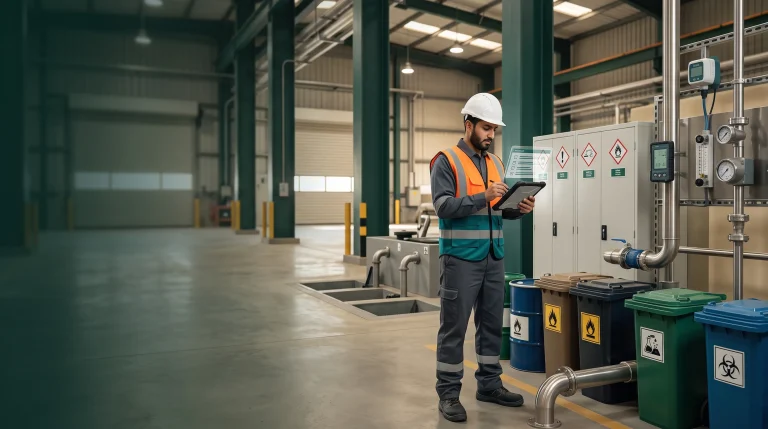
This includes improper storage, mixing hazardous and non-hazardous waste, or contracting with unlicensed transporters.
Second: Air Emissions
Such as failing to maintain filtration systems, operating equipment beyond permitted limits, or the absence of periodic measurements.
Third: Water Discharge
Whether it involves untreated industrial discharge or failure to comply with approved discharge points.
Fourth: Noise and Vibrations
Especially in facilities located near residential areas or during nighttime operations.
The concerning issue is that some of these violations may not be visible to the naked eye, yet they can be easily detected during inspections or through public complaints.
Early warning signs inside a facility before a violation occurs
Smart facilities do not wait for inspections to discover problems. There are early warning signs that, if recognized in time, can prevent environmental violations and fines before they occur. The most common indicators include:
- Delayed or missing environmental maintenance records..
- Repeated complaints from employees or nearby residents.
- Frequent failures in treatment or control systems.
- Lack of clear environmental emergency procedures.
- Operational expansions without updating environmental documentation.
The presence of these signals indicates a compliance gap that requires immediate action, rather than waiting for an inspector’s visit.
Internal compliance policy: responsibilities, records, and periodic reviews
Real prevention begins internally. Establishing an internal environmental compliance policy is one of the most effective tools to avoid environmental violations and fines. This policy does not need to be complicated, but it must be clear and consistently implemented.
- Assigning an environmental officer or compliance team.
- Distributing responsibilities between operations, maintenance, and management.
- Creating updated and easily accessible environmental records.
- Conducting periodic internal reviews (monthly or quarterly).
- Establishing an internal reporting mechanism for any non-compliance.
Facilities that implement these policies typically pass inspections more smoothly, even when minor observations are identified.
Rapid corrective action plan when non-compliance is detected
Detecting an issue early is always better than ignoring it. When any deficiency is identified, a clear corrective action plan should be activated to prevent it from turning into official environmental violations and fines. An effective plan typically includes:
- Documenting the issue immediately.
- Identifying the root cause, not just the symptom.
- Developing a corrective action with a defined timeline.
- Implementing the solution and monitoring its effectiveness.
- Documenting the closure with evidence (photos, reports, invoices).
Regulatory authorities are often flexible when they see serious efforts to address the issue. However, ignoring or delaying action is what usually leads to heavier penalties.
When do you need consulting support to assess compliance gaps?
Not every facility requires a consultant at all times. However, there are situations where external support becomes essential, particularly to avoid costly environmental violations and fines. A facility may need consulting support when:
- The environmental classification is unclear or outdated.
- Operational expansion or process changes occur.
- The same inspection remarks are repeated.
- There is no specialized internal environmental team.
- The facility wants a proactive audit before an official inspection.
This is where specialized companies play an important role, such as provides you with that help organizations assess compliance gaps, prioritize actions, and build a practical, implementable compliance system rather than a purely theoretical one.
Frequently Asked Questions
Can risks be reduced shortly before an inspection?
Yes. Even a quick pre-inspection audit can significantly reduce the likelihood of environmental violations and fines, especially when focusing on critical compliance points.
Is the violation related to the location or the activity?
Both. The type of activity determines the risk level, while the location may increase or decrease sensitivity—especially if the facility is close to residential areas.
How can I prove that the root cause of an observation has been resolved?
Through clear documentation that includes the corrective action taken, the timeline, operational changes implemented, and measurement results after the correction.
Can expansion without updating environmental requirements lead to violations?
Yes. This is one of the most common reasons for unexpected environmental violations and fines, as expansion may change the facility’s classification and regulatory requirements.
In today’s business environment, environmental risks are no longer marginal—they are a core component of financial sustainability. Ignoring small details may lead to significant environmental violations and fines, while smart planning protects the facility, strengthens its reputation, and increases the confidence of regulatory authorities.
contact Al-Buad Environmental team now to learn how to reduce fines and improve your environmental compliance level.
The content was reviewed by a team of environmental experts.
Environmental content at Al-Ba’ad Al-Bia’i Environmental Consulting Company is prepared and reviewed by a team of specialists in environmental studies, environmental impact assessment, environmental compliance, and environmental monitoring.
Meet the expert team