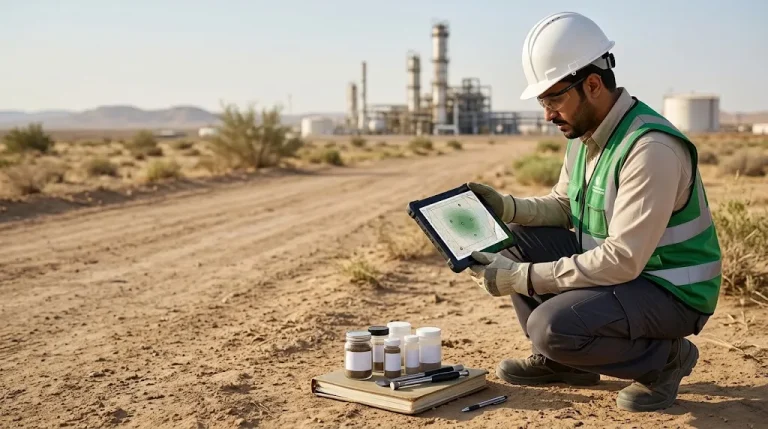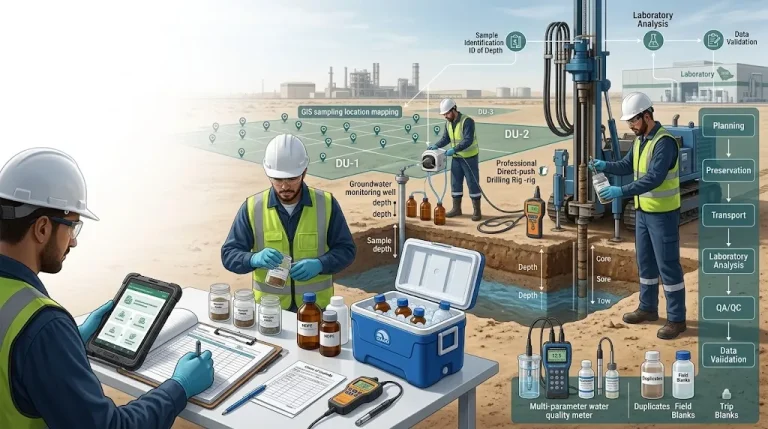


It does not start Environmental commitment with the inspector's visit, nor when a remark or violation is issued, but rather starts inside the facility through a clear system that reviews permits, records, measurements, waste, emissions, emergency plans, and team responsibilities before small gaps turn into costly violations.
Hence comes the importance of preparing Internal environmental compliance plan for facilities in Saudi Arabia; as it is an operational tool that helps management know the actual environmental status, prioritize, prepare the file before inspection, and document corrective actions in a practical way.
This article supports the main article on Environmental Compliance in Saudi Arabia, by focusing on the practical aspect within the facility: How do you prepare? What do you review? Who is responsible? And how do you close gaps before they become violations?
Table of Contents
- What is an internal environmental compliance plan?
- Why do facilities need a compliance plan before inspection?
- The difference between an environmental compliance plan and an environmental management plan (EMP)
- Reviewing permits and environmental requirements within the facility
- Organizing waste records, measurements, and reports
- Internal environmental auditing before the inspector's visit
- How to identify environmental gaps within the facility
- Preparing a clear corrective action plan
- Employee training on environmental compliance requirements
- When does a facility need an environmental consultant to prepare the plan?
- How does Albuad Environmental Company help in preparing the compliance plan?
- Frequently Asked Questions
What is an internal environmental compliance plan?
The internal environmental compliance plan is both a document and a workflow system. It doesn't just outline general commitments; it defines how the facility will ensure its daily, weekly, and monthly environmental compliance, who is responsible for each action, and what records are required to prove implementation.
The plan typically covers environmental permits, operational conditions, waste management, air, noise, and water measurements, handling of chemicals, spill and emergency plans, internal inspection, training, and follow-up on corrective actions.
Key elements of the internal environmental compliance plan
- Inventory of valid environmental permits and licenses.
- Reviewing permit conditions and linking them to operational procedures.
- Identifying sources of environmental impact within the facility.
- Establishing a log for hazardous and non-hazardous waste.
- Establishing a log for environmental measurements and periodic reports.
- Reviewing emergency and spill response plans.
- Defining responsibilities for the environment, safety, and operations team.
- Preparing internal inspection forms.
- Establishing a mechanism for closing observations and gaps.
- Updating the plan upon expansion or changes in activity.
Why do facilities need a compliance plan before inspection?
An inspection visit should not be the first moment a facility discovers its environmental gaps. Advance preparation allows management to review documents, correct errors, train the team, and organize evidence prior to the official visit.
The higher the environmental impact of the facility, the more important it is to have a clear internal plan, because inspections may focus on permits, operational conditions, waste, emissions, hazardous materials, wastewater, soil, noise, or maintenance and measurement logs.
Benefits of the plan before inspection
- Reducing the likelihood of unexpected observations.
- Organizing records and documents before they are requested.
- Identifying gaps and addressing them early.
- Raising the team's readiness during the tour.
- Reducing confusion when drawing samples or reviewing documents.
- Improving the facility's ability to prove its compliance with evidence.
- Transforming the inspection from a defensive stance into an organized review process.
The difference between an environmental compliance plan and an environmental management plan (EMP)
Some confuse the internal environmental compliance plan with the Environmental Management Plan (EMP). Although they are clearly related, each has a different function within the facility's system.
| Comparison | Internal Environmental Compliance Plan | Environmental Management Plan EMP |
|---|---|---|
| Objective | Monitoring compliance with permits, requirements, records, and inspection. | Managing environmental impacts resulting from the facility or project's activities. |
| Focus | Readiness, documentation, gaps, corrective actions. | Dust, noise, waste, emissions, water, soil, emergencies. |
| When is it used? | Before inspection, renewal, expansion, or internal auditing. | During operation or execution to manage daily environmental impacts. |
| Outputs | Checklist, gap log, correction plan, compliance records. | Control procedures, monitoring programs, emergency plans, operational responsibilities. |
Facilities that need to prepare or update an Environmental Management Plan can refer to the service Preparation of EMP environmental management plans.
Reviewing permits and environmental requirements within the facility
The first step in any internal environmental compliance plan is to review the status of the environmental permit. Is the permit valid? Does it cover the actual activity? Has the operational capacity changed? Have new production lines or materials been added? Are there conditions within the permit that have not yet been implemented?
What should be reviewed in the permit file?
- Permit issue date and expiry date.
- Activity name and scope as stated in the permit.
- Facility location and approved coordinates.
- Registered operational or production capacity.
- Environmental monitoring and measurement requirements.
- Waste management and hazardous materials requirements.
- Any obligations associated with the environmental management plan.
- Any previous notes or commitments.
- The need to update the permit upon expansion or modification.
In the case of an expired permit, uncovered activity, or unupdated expansion, the matter must be addressed early through the service Issuance and renewal of environmental permits.
Organizing waste records, measurements, and reports
Environmental records are the practical proof of compliance. A facility might be implementing good procedures, but if it does not document them, it will not be able to easily prove them during review or inspection.
The most important records that must be organized
- Register of environmental permits and licenses.
- Waste transport and disposal record.
- Contracts of waste transporters or treatment entities.
- Hazardous and non-hazardous waste classification record.
- Air quality or stack measurement reports, if any.
- Noise or vibration measurement reports when needed.
- Wastewater, groundwater, or soil analyses according to the activity.
- Spill and environmental incident log.
- Employee training record on environmental procedures.
- Maintenance log for emission control or treatment systems.
- Internal inspection minutes and corrective plans.
Measurements and reviews can be converted into organized technical reports through the service Preparing environmental monitoring reports.
Internal environmental auditing before the inspector's visit
Internal environmental auditing is an organized tour conducted by the facility or an environmental consultant before the official visit, aimed at discovering gaps early. The audit must include the site, documents, operations, and records, not just the office.
What does an internal environmental audit include?
- Reviewing storage and waste areas.
- Inspecting chemical, fuel, and oil locations.
- Reviewing emission, discharge, or noise points.
- Ensuring the presence of spill response equipment.
- Reviewing measurement and maintenance records.
- Matching actual activity with the permit.
- Ensuring clear signage and operating procedures exist.
- Reviewing employee training for emergency situations.
- Documenting observations with photos, location, and the responsible person.
- Preparing a gap report and a corrective plan.
How to identify environmental gaps within the facility
Gap analysis is the heart of the internal environmental compliance plan. Its purpose is to compare the actual situation with what it should be according to the permit, environmental management plan, requirements, and best operational practices.
Examples of common environmental gaps
- Valid permit but does not cover all current activities.
- Presence of hazardous waste without clear separation or classification.
- Absence of a waste transfer log or its irregularity.
- Lack of up-to-date environmental measurement reports.
- Storage of chemicals without updated safety data sheets.
- Absence of a spill response plan.
- Lack of maintenance for filters or emission treatment systems.
- Absence of employee training on environmental emergencies.
- Presence of old remarks that have not been closed with evidence.
- Lack of a clear person responsible for environmental compliance.
Preparing a clear corrective action plan
After identifying the gaps, the facility should not just describe the problem. The requirement is to prepare a corrective action plan detailing the cause, the solution, the responsible person, the timeframe, and the required evidence to close the remark.
Components of a good corrective plan
- Describe the gap or remark accurately.
- Identify the location or activity associated with it.
- Identifying the root cause, not just the symptom.
- Determine the required corrective action.
- Assign the person responsible for implementation.
- Set a target date for closure.
- Specify the required evidence such as photos, reports, or records.
- Review the effectiveness of the action after implementation.
- Update procedures to prevent the recurrence of the gap.
Employee training on environmental compliance requirements
Even the best compliance plan can fail if workers do not know their roles. Therefore, operations, maintenance, warehouse, safety, security, and transportation teams must be trained on the environmental requirements related to their daily work.
Suggested training topics
- Environmental compliance fundamentals within the facility.
- Waste sorting and storage procedures.
- Handling hazardous waste.
- Spill procedures and Spill Kits.
- Handling chemicals and SDS records.
- Environmental incident reporting procedures.
- Maintaining records during operation.
- Preparing for inspection tours.
- Responsibilities of each department within the compliance plan.
When does a facility need an environmental consultant to prepare the plan?
The facility needs an environmental consultant when gaps are complex, when activities have a medium or high environmental impact, when there is a violation or inspection observation, upon expansion, or when preparing the permit renewal file.
Cases requiring specialized support
- Frequent inspection observations.
- Unclear permit or renewal requirements.
- Lack of an updated environmental management plan.
- Presence of hazardous waste or chemicals.
- Need for periodic environmental measurements or reports.
- Activity expansion or adding a production line.
- Occurrence of a spill, accident, or community complaint.
- Need for an internal audit prior to inspection.
This is directly related to a broader question we addressed in an article When does a facility need environmental consultation in Saudi Arabia.
How does Albuad Environmental Company help in preparing the compliance plan?
Albuad Environmental Company supports facilities in preparing and implementing an internal environmental compliance plan appropriate to the nature of their activity, through permit review, gap analysis, record organization, corrective plan preparation, and the design of internal monitoring and inspection programs.
Support services include:
- Reviewing the environmental permit and its requirements.
- Evaluating the current environmental status of the facility.
- Implementing an internal environmental audit prior to inspection.
- Preparing the environmental gaps log.
- Preparing a corrective action plan.
- Organizing waste and measurement records.
- Reviewing spill and emergency plans.
- Preparing or updating the Environmental Management Plan (EMP).
- Training facility teams on compliance procedures.
- Supporting periodic reporting and reviews.
Trust and transparency information E-E-A-T
This article has been prepared to provide practical guidance on the internal environmental compliance plan for facilities in Saudi Arabia. The content is guidance-oriented and does not replace reviewing the requirements of the competent authority or studying each facility's case individually.
- Experience: The article focuses on practical, actionable steps within facilities prior to inspection.
- Jurisdiction: The article explains the difference between the compliance plan and the environmental management plan, connecting each of them to permits, records, and measurements.
- Reliability: The article does not include any guarantee of issuing a permit or canceling a violation; the final decision rests with the competent authorities.
- Transparency: The role of Albuad Environmental Company is to provide technical and consultative support, and to prepare studies, plans, and reports within the agreed service scope.
Frequently Asked Questions about the internal environmental compliance plan
What is an internal environmental compliance plan?
It is an internal system that defines how a facility monitors its environmental commitment through reviewing permits, records, measurements, waste, internal inspections, and corrective actions.
Does the compliance plan differ from the Environmental Management Plan (EMP)?
Yes. The Environmental Management Plan focuses on managing environmental impacts, while the compliance plan focuses on monitoring requirements, records, inspection readiness, and gap closure.
When should the environmental compliance plan be prepared?
It is best prepared before an inspection, permit renewal, expansion, or when there are environmental notes, changes in activity, materials, or operational energy.
What are the most important records required in the compliance plan?
This includes records of permits, waste, environmental measurements, maintenance, training, emergencies, incidents, and corrective action plans.
Does the facility need an environmental consultant to prepare the plan?
A facility may need an environmental consultant if activities have a medium or significant impact, or in the case of violations, expansions, measurement and monitoring requirements, or unclear permit conditions.
How does the plan help reduce violations?
The plan helps detect gaps early, organize records, assign responsibilities, implement corrective actions, and prepare the facility before an inspection visit.
Conclusion
Preparing Internal environmental compliance plan It is not an additional administrative procedure, but rather a tool to protect the facility from gaps, notes, and violations. A facility that knows its permits, organizes its records, reviews its wastes and measurements, and trains its employees is better able to deal confidently with inspection, expansion, and renewal.
Contact Albuad Environmental Company to review your facility's environmental file and prepare an internal compliance plan that helps you prepare for inspection and improve the level of environmental commitment within your site.
The content was reviewed by a team of environmental experts.
Environmental content at Albuad Environmental Company is prepared and reviewed by a team of specialists in environmental studies, environmental impact assessment, environmental compliance, and environmental monitoring.
Meet the expert team