 966535733690 +

Environmental Consultancy for Road Projects in Saudi Arabia

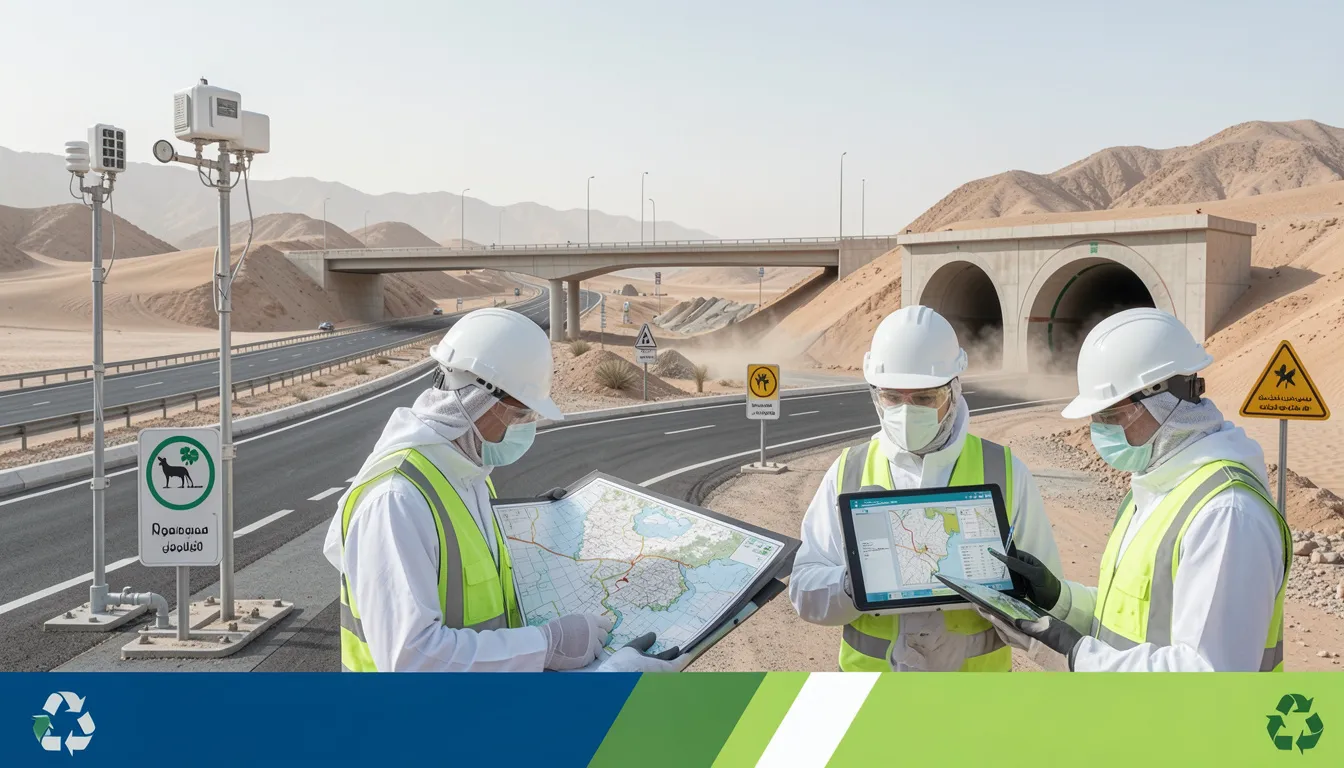
The kingdom of Saudi Arabia is witnessing a major expansion in roads, highways, bridges and tunnels projects, as part of a national trend to build a more integrated and sustainable transport and logistics system based on modern technologies. The success of the road project is no longer measured only by the number of kilometers implemented, but by the quality of the infrastructure, the sustainability of the asset, the safety of users, the protection of communities and sensitive environments surrounding the project.
Hence the importance of Environmental consultancy for road projects in Saudi Arabia, Because it helps project owners, contractors and consultants to integrate environmental requirements from the planning and design stage, not after the adoption of the route or the start of works on site. Any decision related to the route, backfills, cutting and backfilling areas, bridges, tunnels, crushers, asphalt plants, camps, or access roads may create an environmental impact that needs to be assessed, managed, and monitored.
Environmental dimension company provides specialized consulting services for roads, highways, bridges and tunnels projects in Saudi Arabia, by converting environmental requirements into operational plans, performance indicators, monitoring programs, field controls, and reports applicable throughout the project life cycle.
Direct answer: Road, Bridge and tunnel projects need environmental consultations to assess the environmental impact, obtain permits, protect valleys, habitats and biodiversity, manage dust, noise and vibrations, control backfill and drilling waste, prepare environmental management plans for construction, and carry out environmental monitoring and inspection until the closure of the project.
Table of Contents
- The strategic role of Environmental Consulting in road projects
- How environmental consulting supports the priorities of the road sector
- Regulatory framework for road projects in Saudi Arabia
- Environmental services across the road project life cycle
- Environmental impact assessment of road, bridge and tunnel projects
- CEMP construction environmental management plan
- Environmental considerations for bridges and tunnels
- Digital Environmental Management and GIS maps for road projects
- The role of sustainability in the future of road networks and tunnels
- Environmental dimension company as an environmental partner for infrastructure projects
- Trust and transparency information E-E-A-T
- Frequently Asked Questions
The strategic role of Environmental Consulting in road projects
Environmental consultation on road projects should not be treated as a separate procedure for obtaining a permit only. Effective environmental consultations start from the first stages of the project and affect the choice of the route, the design of bridges and ferries, the locations of tunnels, the locations of work areas, storage areas, access roads, and support facilities such as crushers, asphalt plants and concrete plants.
The earlier environmental requirements are integrated into planning, engineering, procurement and implementation, the lower the risk of disruption, costly adjustments and inspection observations. The project also becomes more capable of achieving road quality, public safety, sustainability, and long-term operation and maintenance stability.
Why is it not enough to deal with the environment after the start of implementation
- Because adjusting the route of a road or tunnel site after the design is adopted can be expensive and complicated.
- Because backfill sites or material storage areas may affect nearby valleys, soils or communities.
- Because crushers, asphalt and concrete plants may need independent review and permits or controls.
- Because dust, noise and vibrations may affect safety, nearby communities and facilities.
- Because failure to manage drilling and backfill residues can lead to long-term damage.
This stage can be associated with a service
Environmental impact assessment and environmental audit studies
To identify risks before the adoption of the project or the start of business.
How environmental consulting supports the priorities of the road sector
Good Environmental Consulting does not work in isolation from the objectives of the road project, but rather supports the quality of the road, the safety of users, operational efficiency, asset protection, and the long-term sustainability of the network. That is why environmental management should be part of the project strategy and not a secondary item in the implementation documents.
1. Quality of roads and efficiency of interconnection between regions
Drainage problems, erosion, sediment movement, poor slope stability, or poor choice of backfill sites may lead to future defects in the roadway and increase maintenance costs. Therefore, Environmental Consulting helps to assess valleys, flood zones, cutting and backfilling areas, slope stability, and disposal sites for drilling products.
When these risks are properly managed, environmental management becomes a supporting factor for the quality of the asset, prolonging the life of the road, and reducing future operational costs.
2. Road and community safety
Environmental hazards may directly affect road users, workers and surrounding communities. Dust may reduce visibility, hazardous materials may cause spills or fires, vibrations from some work may affect nearby buildings, and mismanagement of equipment movement may raise safety risks.
Environmental dimension supports these aspects through dust control plans, noise and vibration management, spill prevention, hazardous materials regulation, and emergency response plans.
3. Long-lasting and more sustainable road networks
Environmental consulting supports the sustainability of road projects by reducing unnecessary environmental disturbance, protecting habitats and biodiversity, reusing appropriate materials from excavation, reducing dependence on new raw materials, and improving resource consumption efficiency.
This path can be supported through the service
Ecological studies and inventory of biodiversity
Especially on trails near sensitive habitats or areas.
4. Intelligent transportation and Digital Environmental Management
As infrastructure projects move towards digital solutions, environmental management is becoming more connected with maps, databases, dashboards, and digital field reports. GIS can be used to identify environmental restrictions along the route, correlate observations with locations, and track the results of monitoring and inspection by the longitudinal chain of the route.
Regulatory framework for road projects in Saudi Arabia
Road, Bridge and tunnel projects may be related to several entities and regulatory requirements, depending on the nature of the project, its location, size and sensitivity of the surrounding environment. Therefore, the environmental strategy should begin by determining the Competent Authority, the type of study required, and the sequence of appropriations before implementation.
Entities and paths that may be associated with the project
- Ministry of transport and logistics: They are related to general trends and the development of the transport and logistics system.
- Saudi roads authority and Road Code: Provides technical frameworks related to the planning, design and maintenance of roads, including some aspects related to biodiversity and the environment.
- NCEC National Environmental Compliance Monitoring Center: It is related to environmental permits and regulatory compliance, and some projects may include environmental impact assessment studies depending on the classification.
- Specialized environmental centers: Such as the National vegetation cover development center, the National Wildlife Development Center, and the National Waste Management Center moan, according to the type of impact or activity.
Having a single accreditation or permit does not mean that all supporting activities are automatically covered. Crushers, asphalt plants, concrete plants, landfills, or waste management facilities may need independent review depending on their nature and location.
Facilities and contractors can review the permit requirements via the service
Issuance and renewal of environmental permits
Before the start of implementation or commissioning of supporting facilities.
Environmental services across the road project life cycle
Major road projects need constant environmental support from the tender stage to the final closure. The scope of the service varies depending on the stage of the project, but the goal is fixed: reducing risks, facilitating appropriations, controlling implementation, and documenting compliance.
1. Tender and pre-award support
At the tender stage, Environmental Consulting helps to review the requirements of the employer, analyze the specifications, prepare a preliminary compliance Matrix, identify the main environmental risks, estimate the required resources for management, monitoring and reporting.
2. Early environmental examination of the route
Maps, satellite imagery, field data, and GIS techniques are used to monitor environmental constraints along the trail, such as canyons, vegetation, sensitive areas, nearby communities, landfill sites, and access areas.
3. Evaluation of route alternatives
Alternatives can be compared according to environmental criteria such as the area of affected land, the volume of vegetation clearance, the number of Valley crossings, proximity to sensitive receptors, the cost of Environmental Management, and the impact of each alternative on implementation and maintenance.
4. Determining the scope of the Environmental Impact Assessment Study
This stage determines the study boundaries, environmental and social receptors, field survey programs, required forecast models, monitoring scope, and consultation or coordination paths depending on the project requirements.
5. Preparation of the EIA environmental impact assessment study
The impact assessment study links the project activities with the affected environment, and usually includes an analysis of possible impacts during construction and operation, with the application of a mitigation sequence: avoidance, minimization, restoration, and then compensation when needed.
6. Preparation and implementation of the Environmental Management Plan for construction
After the approval of the study or requirements, the obligations are transferred to an operational plan of the site, which includes dust, noise, waste, hazardous materials, spills, equipment movement, protection of canyons, backfill management, and follow-up of subcontractors.
7. Monitoring, inspection and reports
During implementation, projects need environmental inspection visits, field measurements, periodic reports, follow-up of nonconformities, and documentation of corrective actions. This can be supported via the service
Preparing environmental monitoring reports.
8. Final environmental closure
At the end of the project, closure reports are prepared, temporary work areas are restored, waste is removed, any possible contamination is addressed, rehabilitation is documented, and the site is handed over in accordance with the agreed environmental requirements.
Environmental impact assessment of road, bridge and tunnel projects
EIA requirements vary depending on the classification of the project, its length, location, associated facilities, and the quality of the surrounding environmental receptors. Projects with the greatest impact may require a scoping report, a detailed impact assessment study, and project-specific management and monitoring plans.
The most important aspects that are evaluated
- The impact of the track on the valleys and flood zones.
- The removal of vegetation and its impact on biodiversity.
- Influence on the fungal life and movement of organisms.
- Dust from digging, backfilling and truck traffic.
- Noise and vibrations caused by equipment or detonation.
- Management of drilling products, construction and demolition waste.
- Hazardous materials, fuels and oils at work sites.
- Temporary sewage and campsites.
- Sensitive receptors such as residential communities or nearby facilities.
- The impact of future operation on noise, safety and the surrounding environment.
All these elements help to build a project more clearly in terms of risks, costs and obligations, reduce surprises during implementation.
CEMP construction environmental management plan
The construction environmental management plan is one of the most important control tools in road projects, because it turns undertakings and studies into clear field actions that the contractor and the site team can implement and measure.
What should be included in the Environmental Management Plan for construction
- Roles and responsibilities of the environmental management team.
- Dust and emission control procedures.
- Noise and vibration control procedures.
- Management of drilling and backfill products.
- Management of construction and demolition waste.
- Management of hazardous substances, fuels and oils.
- Spill prevention and Emergency Response Plan.
- Protection of valleys and natural drainages.
- Measures to protect vegetation and biodiversity.
- Environmental monitoring and measurement program.
- The system of internal inspection and non-conformities.
- The mechanism of periodic reporting and closing notes.
This plan can be prepared or updated through the service
Preparation of EMP environmental management plans
For road, construction and infrastructure projects.
Environmental considerations for bridges and tunnels
Bridges and tunnels need additional environmental considerations compared to some conventional road segments, due to the nature of engineering works, deep excavation, possible blasting, management of excavation outputs, gate locations, ventilation, foundations, and passage through sensitive areas such as canyons or steep slopes.
Environmental considerations in bridge projects
- Protection of valleys and watercourses during the construction of supports.
- Prevent the leakage of concrete, oil or fuel into the soil or water.
- Management of earthworks around the foundations.
- Reduce the impact on vegetation and sensitive areas.
- Control dust and noise during heavy work.
- Management of temporary storage areas near natural sewers.
Environmental considerations in tunnel projects
- Management of waste and products of tunneling.
- Control vibrations caused by drilling or blasting.
- Management of leaking water or drainage water inside the tunnel.
- Evaluation of the impact of tunnel Gates and ventilation areas.
- Control of dust and air inside the working areas.
- Management of hazardous materials and fuels within a more sensitive operating environment.
- Prepare emergency plans for limited access areas.
In case there are chemicals, fuel or risks of spills inside the bridge and tunnel sites, the project can be supported through a service
Chemical Safety Consulting in Saudi Arabia.
Digital Environmental Management and GIS maps for road projects
Road projects span long distances, and their environmental conditions change from one sector to another. Digital tools and GIS maps therefore help to transform environmental information into a system that can be followed up and implemented on site.
Examples of digital management applications
- Maps of environmental restrictions along the route.
- Environmental records associated with the longitudinal chain of the road chain.
- Determination of environmental monitoring sites with accurate coordinates.
- Digital dashboards for notes and non-matches.
- Document photos and notes geographically.
- Tracking the closure of corrective actions by sector and contractor.
- Correlate the measurement results with locations and time periods.
- Improve the quality of monthly and periodic reports.
This methodology helps to increase the transparency of implementation, facilitate the follow-up of subcontractors, and improve the speed of decision-making when a problem arises in a particular location.
The role of sustainability in the future of road networks and tunnels
Professional environmental consulting supports the sustainability goals of road projects by reducing resource consumption, reusing appropriate materials, reducing the impact on habitats, efficient waste management, improving site quality after closure, and monitoring environmental performance indicators during implementation.
With the expansion of road networks, bridges and tunnels in Saudi Arabia, sustainability becomes an influential element in the quality of the project and not just a cosmetic addition. A sustainable road is a safe, long-lasting road that has less impact on the environment and is better able to serve society and the economy for many years.
Indicators that can be tracked in road projects
- The quantities of reused drilling materials.
- The amounts of construction waste that have been recycled or managed in a safe way.
- The number of dust, noise and spills notes.
- The percentage of non-matches closing on time.
- The number of effective environmental monitoring sites.
- Areas of vegetation that have been avoided or protected.
- The percentage of implementation of rehabilitation procedures after the completion of works.
Environmental dimension company as an environmental partner for infrastructure projects in Saudi Arabia
The success of a road project is not limited to design and implementation, but also depends on the project's ability to achieve quality, safety, sustainability and compliance while protecting communities, natural resources and surrounding ecosystems.
The environmental dimension company provides an integrated support model for Road, Bridge and tunnel projects, combining organizational knowledge, understanding the nature of infrastructure projects, environmental studies, Geographic Information Systems, field monitoring, contractor control, and digital reports.
The environmental dimension company supports the following entities:
- Owners of government and private projects.
- Road and highway contractors.
- Design & Build design & construction unions.
- Contractors of bridges and tunnels.
- Engineering offices and consultants.
- Road operators and maintenance contractors.
- Infrastructure developers and investors.
Environmental support services include:
- Early environmental examination of the tracks.
- Preparation of Environmental Impact Assessment studies.
- Support of permits and regulatory requirements.
- Preparation of environmental management plans for construction.
- Preparation of monitoring programs and environmental measurements.
- Dust, noise and vibration management.
- Biodiversity and Habitat studies.
- Waste management, drilling and construction waste.
- Environmental inspection and closure of nonconformities.
- Reports on the closure and rehabilitation of work areas.
Trust and transparency information E-E-A-T
This article has been prepared to clarify the role of Environmental Consulting in roads, highways, bridges and tunnels projects in Saudi Arabia, focusing on the practical, organizational and technical aspects that project owners, contractors and consultants need during planning, implementation and closure.
- Experience: The article focuses on real-life field challenges in road projects, such as dust, noise, vibrations, canyons, backfills, drilling products, and temporary work sites.
- Jurisdiction: The article details the cycle of environmental support from tender and early inspection to impact assessment, management plans, monitoring and closure.
- Reliability: The article does not include any guarantee of obtaining a permit or accreditation; the final decision belongs to the competent authorities depending on the nature of the project and its documents.
- Transparency: The role of the environmental dimension company is to provide technical and consulting support and prepare studies, plans and reports within the agreed scope of Service.
Frequently asked questions about environmental consulting for road projects in Saudi Arabia
What environmental study is needed for a road project in Saudi Arabia
The type of study depends on the classification of the project, its length, location, associated facilities, and the sensitivity of the surrounding environment. Some projects may require a scoping report, a detailed environmental impact assessment study, and project-specific management and monitoring plans.
When should the Environmental Consultant be appointed for the road project
It is preferable to appoint an environmental consultant during the feasibility or preliminary design phase, before installing the final route, bridge sites, tunnels and support facilities, so that environmental requirements are integrated into design and implementation decisions.
Does the road project permit automatically cover crushers and asphalt plants
This should not be assumed. Each supporting activity such as crushers, asphalt plants, concrete plants, backfill areas, or labor camps should be inspected to determine its independent regulatory and environmental requirements.
Can the environmental dimension company support the contractor during the implementation
Yes, the contractor can be supported in the implementation of the construction environmental management plan, monitoring, inspection, audit, reporting, subcontractor control, and closing environmental nonconformities.
Do the services include bridges and tunnels projects
Yes, services can include the assessment and management of blasting and vibration works, tunnel drilling products, tunnel Gates, ventilation areas, bridge foundations, canyons, steep slopes, and sensitive receivers.
Can environmental documents be prepared for the tender stage
Yes, environmental methodologies for the tender, compliance matrices, team plans, preliminary monitoring programs, risk logs, and environmental cost inputs can be prepared to support the contractor's or consultant's bid.
What are the most important environmental risks in road projects
The most important risks include dust, noise, vibrations, management of landfills and drilling products, protection of valleys, vegetation removal, waste management, hazardous materials, and the risk of spills at work sites.
How GIS systems help in the environmental management of road projects
GIS systems help identify environmental restrictions along the route, link observations to locations, track monitoring points, and geographically document corrective actions to improve the quality of monitoring and reporting.
Conclusion
Represent Environmental consultancy for road projects in Saudi Arabia An essential element in the success of road, highway, bridge and tunnel projects, because they link regulatory compliance, asset quality, user safety, environmental protection, and long-term sustainability of the project.
From the first road route audit to the final environmental closure report, environmental dimension helps projects move with greater organizational clarity, stronger field control, and fewer environmental risks.
Get in touch with environmental dimension to get specialist support for your road, bridge or tunnel project, ensuring compliance and sustainability requirements are integrated at every stage of the project.
The content was reviewed by a team of environmental experts.
Environmental content at Al-Ba’ad Al-Bia’i Environmental Consulting Company is prepared and reviewed by a team of specialists in environmental studies, environmental impact assessment, environmental compliance, and environmental monitoring.
Meet the expert team