

A major chemical incident does not always start with a clear explosion or a widespread leak that can be noticed from the first moment. Often, the problem begins with small details: an unlabeled container, an outdated Safety Data Sheet (SDS), an oxidizer stored next to a flammable material, a corroded discharge hose, a valve left open, or chemical waste collected in a container unsuitable for its nature.
A facility may operate for years without a major incident, but the absence of incidents does not mean the system is safe. Chemical safety management does not rely solely on providing gloves and fire extinguishers or keeping Safety Data Sheets in a paper file; rather, it requires an integrated system that connects the materials on-site, hazard characteristics, quantities, storage locations, chemical compatibility, methods of use, emergency scenarios, and safe disposal procedures.
Albuad Environmental Company provides services Chemical Safety Consulting in Saudi Arabia and the management of hazardous materials and industrial risks from an environmental and operational perspective, focusing on inventory, classification, safe storage, document review, emergency plans, chemical waste management, and gap analysis. When a project requires specialized independent disciplines such as advanced process safety, fire protection, or specialized laboratory testing, coordination is carried out with appropriate entities or experts depending on the scope of work.
Table of Contents
- Why has chemical safety become a strategic service in Saudi Arabia?
- What is meant by hazardous chemical materials management?
- The difference between chemical hazard and risk
- The difference between chemical safety and process safety
- Preparation of the chemical materials log
- Review of Safety Data Sheets (SDS)
- Compatibility matrix and safe storage
- Process risk assessment HAZOP, FMEA, and QRA
- Spill response plans and chemical waste management
- Albuad Environmental Company methodology
- Trust and transparency information E-E-A-T
- Frequently Asked Questions
Why has chemical safety become a strategic service in Saudi Arabia?
The Kingdom of Saudi Arabia is witnessing a clear development in the governance of the chemical lifecycle, starting from manufacturing or importing, through transportation, storage, and handling, up to treatment and final disposal. This shift makes chemical materials management an essential part of the environmental and operational compliance system within factories, facilities, warehouses, and laboratories.
Chemical safety is no longer just an internal procedure carried out by a safety officer; it has become an integrated file that intersects with the environment, occupational health, storage, transportation, emergencies, waste management, inspection readiness, and business continuity. A facility that does not have a clear log of its chemical materials may face difficulty in assessing risks, responding to incidents, or proving the level of compliance during review.
And if your facility needs to link the chemical safety file with permitting requirements or environmental compliance, you can review the service Issuance and renewal of environmental permits to learn how to organize environmental requirements related to facilities and activities.
What is meant by hazardous chemical materials management?
Hazardous chemical management is the system through which a facility controls a substance from the moment of considering its purchase until the disposal of the container or the waste resulting from it. This includes assessment, acceptance, storage, use, internal transport, emergency response, and safe disposal.
A facility cannot manage the risks of a substance whose location, quantity, or characteristics it does not know. Therefore, chemical management begins with accurate inventory, then classification, and then designing appropriate controls for each substance or group of substances.
The chemical substance lifecycle includes the following:
- Assessing the actual need for the substance before purchasing.
- Searching for a less hazardous alternative when possible.
- Reviewing the Safety Data Sheet (SDS) and chemical classification.
- Approving the purchase from the appropriate supplier.
- Inspecting the substance upon receipt and ensuring the integrity of the containers.
- Applying appropriate warning labels.
- Entering the substance into the facility's chemical register.
- Storing the substance according to chemical compatibility rather than alphabetical order only.
- Defining internal transport controls and safe use.
- Preparing appropriate emergency and spill procedures.
- Managing empty containers and resulting chemical waste.
- Updating the register when the use of the substance ends or it leaves the site.
The difference between chemical hazard and risk
It is important to distinguish between Hazard AndRiskHazard is the inherent property of the substance itself, such as flammability, corrosiveness, toxicity, or reactivity with water. Risk, on the other hand, is the probability of actual harm occurring as a result of exposure to this hazard, taking into account the severity of the consequences and the likelihood of occurrence.
A substance may be highly hazardous, but the resulting risk is low if the quantity is small, stored in a closed system, well-monitored, and used by a trained team. Conversely, a relatively less hazardous substance can cause significant risk if used in massive quantities, in a poorly ventilated area, without training or emergency procedures.
Therefore, it is not enough to just know the name of the substance or the hazard symbol; one must evaluate the quantity, method of use, degree of exposure, storage conditions, potential for leaks, presence of ignition sources, and available protective barriers.
What is the difference between chemical safety and process safety?
Chemical safety usually focuses on protecting workers and the environment from direct exposure to materials, regulating storage, labeling, safety data sheets, personal protective equipment, and small spill response. Process safety focuses on preventing major, low-frequency, high-consequence accidents.
Chemical safety focuses on:
- Safety Data Sheets (SDS) and warning labels.
- Material storage and segregation of incompatible materials.
- Personal protective equipment and training.
- Handling small spills.
- Management of chemical waste and empty containers.
- Minimizing direct worker exposure.
Process safety focuses on:
- Preventing loss of containment in tanks or pressurized lines.
- Evaluating large-scale explosion or fire scenarios.
- Analyzing deviations in pressure, temperature, flow, and composition.
- Evaluating engineering barriers, alarm systems, and shutdown systems.
- Analyzing major accidents that could impact areas beyond the facility boundary.
In major industrial facilities, a facility may need to combine both programs: daily chemical safety for material management, and advanced process safety for studying major accident scenarios.
Preparation of the chemical materials log
The chemical inventory log represents the starting point for any effective hazardous materials management program. It is impossible to assess risks, establish a storage matrix, or prepare an emergency plan without precise knowledge of the materials present, their locations, quantities, and classifications.
A good register is not just a list of names, but an operational database that helps management, supervisors, and emergency teams understand the chemical situation inside the facility quickly and clearly.
| Statement in the register | Technical and administrative purpose |
|---|---|
| Trade name | Identifying the product actually used on-site. |
| Chemical name | Linking the product to its chemical components or mixture. |
| CAS number | Preventing confusion between substances with similar names. |
| Supplier or manufacturer | Facilitating communication and updating documents when needed. |
| Use and process | Identifying the department or process using the substance. |
| Current and maximum quantity | Evaluating inventory volume and its impact on risks and emergency plans. |
| Storage location | Facilitating inspection, incident response, and linking the substance to the site map. |
| GHS classification and physical state | Understanding the nature of the hazard: gas, liquid, solid, flammable, toxic, corrosive, or oxidizing. |
| SDS date and incompatible materials | Verify document freshness and design the storage compatibility matrix. |
| Generated waste | Link the material to the safe disposal and hazardous waste management pathway. |
Review and standardize Safety Data Sheets (SDS)
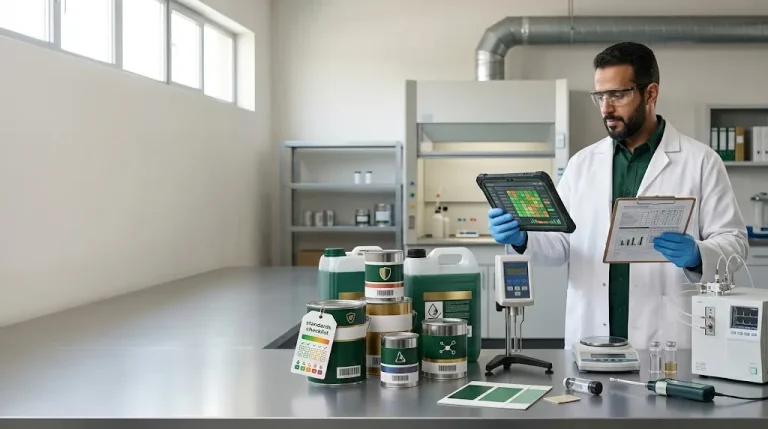
The Safety Data Sheet (SDS) is considered one of the most important technical references for understanding chemical properties, storage methods, personal protective equipment, first aid procedures, firefighting, spill response, and environmental hazards. However, simply having an SDS inside the facility is not enough if it is outdated, not understood, or does not pertain to the product actually in use.
Key issues with Safety Data Sheets inside facilities
- Using old versions that have not been updated for years.
- Presence of sheets in a language that direct workers do not understand.
- Mismatch between the product name in the SDS and the product on-site.
- Absence of supplier data or emergency numbers.
- Failure to use the information contained in the SDS within work procedures and training.
- Keeping the sheets in a file far from the areas of actual use.
Albuad Environmental Company helps facilities review Safety Data Sheets and link them to the chemical register, storage matrix, and emergency plans, transforming the SDS from an archived document into an actionable operational tool.
Designing the Chemical Compatibility and Safe Storage Matrix
One of the common mistakes in chemical warehouses is arranging materials alphabetically or by supplier only. This method may place two highly reactive materials next to each other, increasing the chances of a dangerous reaction in case of a leak, breakage, or mishandling.
Safe storage relies on understanding material properties and classification, reviewing handling, storage, stability, and reactivity sections in the SDS, and analyzing concentration, package size, temperatures, ventilation, and the presence of ignition sources or moisture.
Basic rules for chemical segregation
- Acids and Alkalis: Must be segregated to avoid exothermic reactions.
- Oxidizing materials: They must be kept away from organic materials, oils, and flammable substances.
- Flammable materials: They require proper storage away from heat, sparks, and ignition sources.
- Water-reactive materials: They must be stored in dry places away from sources of moisture.
- Cyanides and sulfides: They must not be brought close to acids to avoid the release of toxic gases.
- Chemical waste: It must be separated according to compatibility and not collected randomly in a single container.
When chemical materials and industrial waste are present, this part can be linked to the service of Waste Management and Waste Reduction to support the organization of waste streams and improve management efficiency within the facility.
Process risk assessment and HAZOP, FMEA, and QRA studies
When a facility deals with large quantities of hazardous materials or complex industrial processes, advanced risk studies become important to understand potential scenarios and determine the required engineering and administrative barriers. These studies are not used as a formal procedure, but rather as a tool to make safer design and operation decisions.
HAZOP Study
HAZOP is a structured study that examines potential deviations from normal design or operating conditions, such as increased pressure, reduced flow, high temperature, composition change, or control system failure. It aims to identify causes, consequences, existing barriers, and necessary recommendations.
FMEA Analysis
FMEA focuses on analyzing potential failure modes in system components, such as pumps, valves, sensors, ventilation systems, or control units. It helps improve reliability and reduce the likelihood of impactful failures.
Quantitative Risk Assessment (QRA)
QRA is used when a facility needs a numerical estimation of hazard scenarios, such as toxic gas leaks, flammable clouds, or high-impact accidents. It relies on probability modeling, consequences, and potential impact zones.
These advanced studies must be implemented within appropriate specialty scopes, with the participation of safety, operations, and engineering teams, and relevant authorities when needed. They should not be treated as ready-made templates, because the quality of their outputs depends on data accuracy and the understanding of design and operation.
Spill response plans and chemical waste management
Any facility dealing with chemicals must have a clear plan to respond to spills and accidents. An unconsidered response may increase the risk rather than reduce it, especially if incompatible absorbent materials are used or if chemicals are mixed randomly.
Components of the Spill Response Plan
- Identifying the types of materials present and their hazards.
- Providing appropriate Spill Kits suitable for the nature of the materials.
- Determining evacuation, isolation, and internal reporting procedures.
- Preventing spills from reaching drainage networks or soil.
- Determining appropriate personal protective equipment for each scenario.
- Training workers on practical response rather than just theoretical.
- Documenting incidents and corrective actions after each occurrence.
Chemical Waste Management
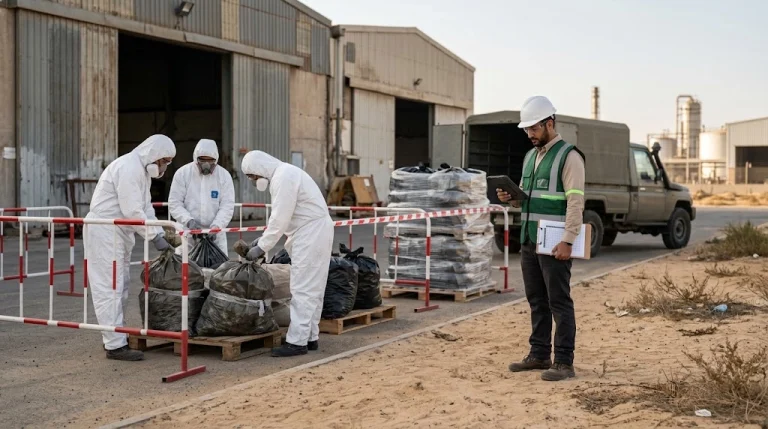
Chemical wastes require clear classification according to hazard characteristics and chemical compatibility. It is not permissible to collect all wastes in a single container simply because they are "chemical", as some mixtures may generate heat, gases, fires, or hazardous reactions.
For factories, workshops, and facilities that need to organize the hazardous waste file, you can check out the service Hazardous Waste Management Permit and service Waste Transportation Permit Within the location of the environmental dimension.
The relationship of chemical safety to the Environmental Management Plan (EMP)
In many facilities, the chemical safety file should not be separate from the environmental management plan. Chemicals may affect the air, soil, water, waste, operational safety, and emergency plans. Therefore, hazardous materials must appear within the environmental management plan as one of the important aspects that require clear controls, monitoring, and responsibilities.
Facilities that need broader organization of environmental aspects can refer to the service Preparation of EMP environmental management plans to determine aspects, impacts, procedures, responsibilities, and monitoring programs.
When does a facility need chemical safety consultations?
Not all chemical facilities are huge or high-risk, but any facility that deals with chemical materials in influential quantities or characteristics needs organized management. The need clearly appears in the following cases:
- Presence of flammable, toxic, corrosive, or oxidizing materials.
- Lack of an updated chemical log.
- Presence of unidentified containers or unclear labels.
- Storing different materials in a single warehouse without a compatibility matrix.
- Repetition of small spills or incidents.
- Presence of unclassified chemical waste or stored for long periods.
- Preparing for an environmental or operational inspection or audit.
- Expanding production lines or adding new materials.
- The need to train workers on safe handling and emergencies.
- Suspecting SDS incompatibility with the materials actually used.
Al-Boud Al-Bia'ee Company methodology in providing chemical safety consultations
Al-Boud Al-Bia'ee Company relies on a practical methodology that begins with understanding the activity, materials, and processes before proposing any model or plan. The goal is not just to prepare a paper file, but to build a system that helps the facility know its materials, reduce its risks, and improve its readiness for operation, inspection, and emergencies.
1. Scoping
We begin by studying the nature of the activity, processes, quantities, storage locations, types of materials, and points of use, then determine the appropriate service scope: chemical log, SDS review, compatibility matrix, emergency plan, or risk assessment.
2. Document Collection
Material lists, safety data sheets, site plans, waste logs, incident logs, emergency plans, and any internal procedures related to chemical materials are collected and reviewed.
3. Field Survey
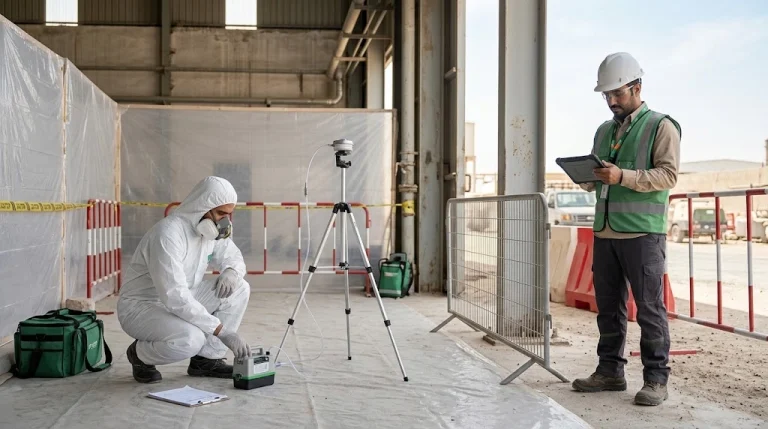
The survey includes inspecting actual inventory, labels, warehouses, unloading areas, containment systems, ventilation, emergency equipment, and internal transport routes within the facility.
4. Gap Analysis
Observations are classified by severity level, and urgent, medium, and long-term corrective actions are determined, while clarifying responsibilities and priorities.
5. Preparing the System and Plans
This phase includes preparing the chemical registry, compatibility matrix, storage and handling procedures, spill response plan, and linking chemical waste to a safe management pathway.
6. Training and Verification
Workers are trained on operational procedures, equipment readiness is reviewed, drills are conducted when needed, and gaps are closed through clear follow-up reports.
To view the broader range of environmental services offered by the company, you can visit the page Albuad Environmental Company Services.
Outputs of Chemical Safety Consulting Service
Outputs vary depending on the project scope, facility size, and nature of the materials, but may include:
- Updated and organized chemical registry.
- Review and consolidation of Safety Data Sheets (SDS).
- List of high-risk or incompatible materials.
- Chemical compatibility matrix for storage.
- Recommendations for improving warehouses and unloading areas.
- Chemical spill response plan.
- Chemical or hazardous waste management plan.
- Gap report outlining priorities and corrective actions.
- Training materials or awareness sessions for workers.
- Recommendations regarding the need for advanced studies such as HAZOP or QRA when applicable.
This article was prepared to clarify the importance of Chemical Safety Consulting in Saudi Arabia And the management of hazardous materials and industrial risks, relying on general technical concepts and regulatory information published by official authorities. This content is guide-based and does not replace reviewing official requirements or consulting industrial safety, fire protection, or certified laboratory specialties when the project scope requires it.
- Experience: The article presents common practical cases within facilities such as the chemical registry, SDS, incompatible storage, spills, and chemical waste.
- Jurisdiction: The article explains the difference between chemical safety, hazardous materials management, and process safety, while explaining tools such as HAZOP, FMEA, and QRA.
- Reliability: The article does not include any claim guaranteeing passing inspection or obtaining regulatory approval; the final decision rests with the competent authorities and the official review process.
- Transparency: The role of the Albuad Environmental Company mentioned here is limited to technical and environmental consultancy support within the scope of agreed services, coordinating with independent specialties when needed.
Common mistakes in hazardous chemical management
- Storing materials alphabetically instead of by chemical compatibility.
- Presence of containers without clear labels or appropriate hazard data.
- Depending on outdated SDS sheets or ones that do not match the product in use.
- Lack of a chemical register showing quantities, locations, and uses.
- Mixing different chemical wastes into a single container.
- Using general absorbent materials without checking chemical compatibility.
- Lack of practical training on spills and emergencies.
- Absence of secondary containment in storage or handling areas.
- Adding new materials to the site without prior risk assessment.
- Failing to link chemical management with the environmental management plan and permits.
Frequently asked questions about chemical safety consulting and hazardous materials management
Is having Safety Data Sheets (SDS) in the facility sufficient to prove compliance?
No. Having an SDS is important, but not sufficient on its own. The information in the sheets must be translated into a clear chemical inventory, proper labels, compatible storage, worker training, emergency plans, and practical on-site procedures.
Is it permissible to store chemicals alphabetically for easier access?
This is not recommended, as alphabetical arrangement may place incompatible materials next to each other. Proper storage must be based on the material's properties, classification, and chemical compatibility, not just the name.
When does a facility need a HAZOP study?
A facility typically needs a HAZOP when it has interconnected industrial processes, large quantities of hazardous materials, or pressure, temperature, and chemical reaction systems that could lead to major accidents if an operational deviation occurs.
What is the difference between HAZOP and FMEA?
HAZOP studies potential process deviations such as pressure, flow, and temperature, whereas FMEA focuses on how each component in a system fails and the impact of that failure on operation and safety.
Can all chemical wastes be collected in a single container?
No. Mixing chemical wastes without a compatibility assessment may lead to dangerous reactions, heat, toxic gases, or fires. Each waste stream must be classified according to its properties and managed separately.
What are the most important outputs of chemical safety consulting?
Outputs typically include the chemical inventory, SDS review, compatibility matrix, storage recommendations, spill response plan, chemical waste management plan, and a gap report with corrective actions.
Is chemical safety related to environmental permitting?
It may be related depending on the nature of the activity, the materials used, and potential impacts. Facilities dealing with hazardous chemicals or wastes may need environmental procedures and documents that support the permit file or environmental management plan.
Can a consulting firm guarantee passing an inspection?
No promise of an absolute guarantee should be relied upon. A consulting firm can improve facility readiness, organize records, identify gaps, and support corrective actions, but the inspection decision or approval rests with the competent authorities.
When should the chemical inventory be updated?
It must be updated when purchasing a new material, changing a supplier, changing the quantity or storage location, removing a material from use, releasing an updated SDS, or experiencing changes in operations or resulting wastes.
What is the relationship between hazardous materials management and hazardous waste management?
Hazardous materials management focuses on the material during procurement, storage, and use, while hazardous waste management focuses on the resulting waste generated after use. Connecting the two is essential to ensure traceability, compliance, and risk reduction.
Conclusion
Represent Chemical Safety Consulting in Saudi Arabia an important element for protecting workers, the environment, and business continuity. A facility that knows its materials, understands their hazards, segregates them correctly, trains its workers, and has a clear emergency plan is better equipped to reduce accidents, prepare for inspections, and handle operational changes.
Chemical safety is not just a paper file; it is an operational system that starts with inventory and classification and ends with training, verification, and continuous improvement. The earlier and more realistically this system is built, the easier it is to implement and the less costly it becomes during expansion or review.
If your facility deals with chemicals or hazardous waste and requires a technical review, the Albuad Environmental Company team can assist you in preparing the material register, reviewing SDS, designing the storage matrix, developing a spill response plan, and improving environmental compliance readiness.
Contact Albuad Environmental Company To request an initial assessment of chemical risks within your facility and determine the appropriate steps to build a more organized and reliable chemical safety system.
The content was reviewed by a team of environmental experts.
Environmental content at Albuad Environmental Company is prepared and reviewed by a team of specialists in environmental studies, environmental impact assessment, environmental compliance, and environmental monitoring.
Meet the expert team