 966535733690 +

Sustainable certification in Saudi Arabia: a comprehensive guide to assessing the sustainability of buildings and communities

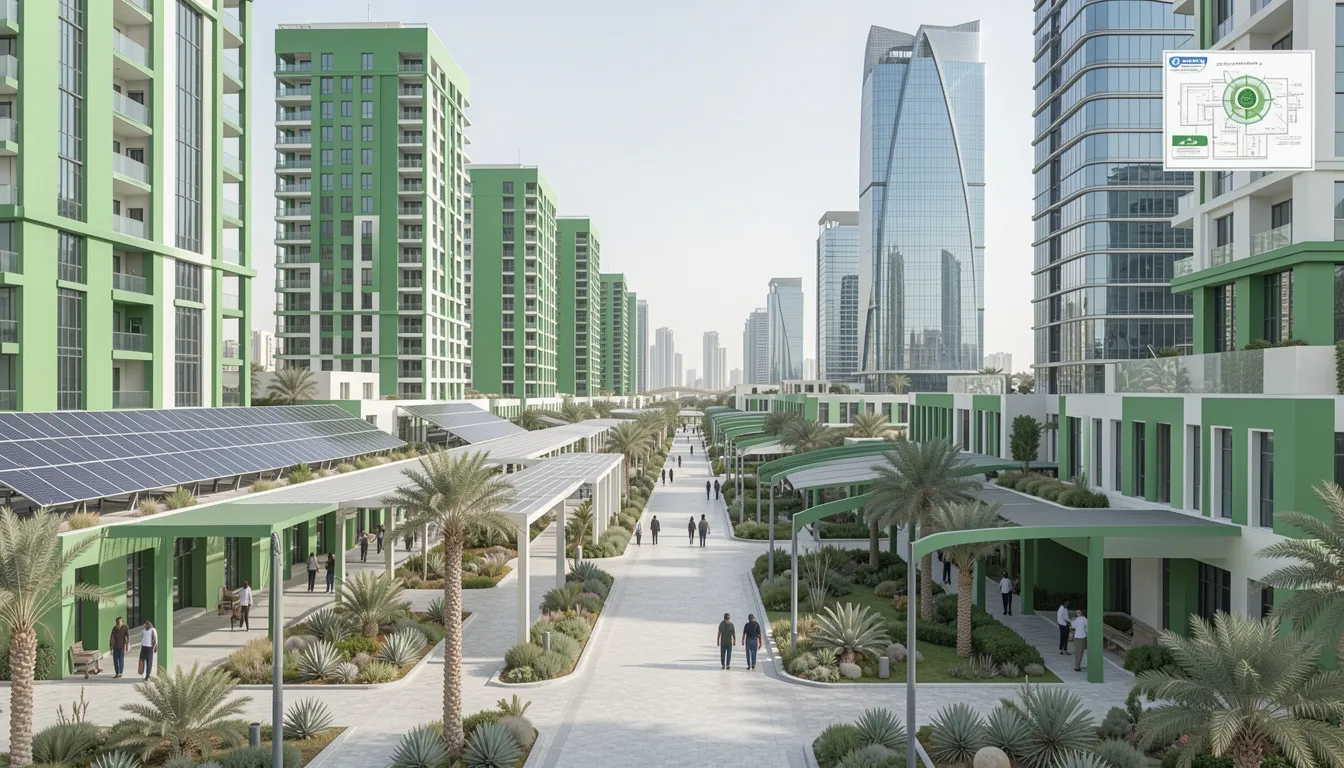
I became Sustainable certification in Saudi Arabia One of the most important sustainability assessment systems for buildings and communities, especially with the kingdom's orientation towards improving the quality of life, raising the efficiency of energy and water consumption, reducing environmental impact, and encouraging the development of more efficient and sustainable buildings and communities. Sustainability in the construction sector is no longer just a cosmetic addition or a marketing element, but has become part of the quality and long-term operational value of the project.
A sustainable building depends not only on the use of energy-saving lamps or the addition of green spaces, but it is based on an integrated system that starts from site selection, and extends to design, building materials, energy efficiency, water management, indoor air quality, waste management, user comfort, operation and maintenance, and performance measurement after occupancy.
In this guide, we explain the meaning of a sustainable certificate, the types of projects covered by the system, the levels of evaluation by points, the main categories, the steps of applying through the sustainable construction platform, the validity period of the certificate, the difference between it and the environmental permit and the building code, and how the environmental dimension company can support developers and project owners in the environmental aspects associated with sustainable projects.
Direct answer: Sustainable certification in Saudi Arabia is a national assessment system that aims to measure and improve the sustainability of buildings and communities in terms of energy and water efficiency, indoor environmental quality, materials and waste management, site sustainability, and sustainable operation. The certificate is awarded according to the points achieved and the level of evaluation, with the need to meet the mandatory requirements that apply to the project.
Table of Contents
- What is a sustainable certificate in Saudi Arabia
- Why sustainable certification has become important for buildings and communities
- Does a sustainable certificate cover the Saudi building code or environmental permit
- What types of projects are covered by a sustainable system
- Sustainable certification levels in Saudi Arabia in points
- What are the main categories of sustainable criteria
- Stages of obtaining a sustainable certificate in Saudi Arabia
- Steps to apply for a sustainable certificate via the platform
- The validity period of the sustainable certificate
- The role of environmental management plans in sustainable projects
- How does the environmental dimension company support sustainable certification projects
- Trust and transparency information E-E-A-T
- Common mistakes when seeking a sustainable certificate
- When to start the sustainable certification procedure
- Frequently asked questions about sustainable certification in Saudi Arabia
What is a sustainable certificate in Saudi Arabia
It aims to assess the sustainability of buildings and communities according to local standards that take into account the kingdom's climatic conditions, the needs of the real estate market, the goals of quality of life and resource efficiency.
A sustainable system differs from global assessment systems such as LEED or BREEAM In that it is designed to suit the Saudi context, both in terms of climate, water consumption, operating patterns, local identity, user requirements, and national targets related to sustainability.
It is important to understand that the sustainable certificate is not just a certificate that is placed on the front of the project, but it is a technical path that requires early planning, coordination between the design, implementation and operation teams, and the preparation of evidence and documents proving that the project achieves the required sustainability standards.
Why sustainable certification has become important for buildings and communities
Sustainable certification is becoming increasingly important because it helps developers and owners to raise the efficiency of the project and improve its operational quality. A sustainable project not only serves the environment, but also reflects on reducing operational costs, improving user comfort, raising the quality of design, and enhancing the market value of the property.
- Improve energy efficiency and reduce operational costs.
- Reduce water consumption through proper design and fittings.
- Raise the indoor air quality and comfort of users.
- Reduce the waste generated by construction and operation.
- Promote the use of sustainable and local materials whenever possible.
- Improve site management and reduce environmental impacts during construction.
- Support operation and maintenance decisions after project delivery.
- Improve the attractiveness of the project for investors and users.
And if your project needs to link sustainability requirements with permits and environmental studies, you can check the service
Issuance and renewal of environmental permits
To find out how the environmental requirements of projects can be equipped.
Does a sustainable certificate cover the Saudi building code or environmental permit
No.no. A sustainable certificate does not dispense with the Saudi Building Code, nor does it dispense with environmental or municipal permits or the approvals of the competent authorities when applicable. Each path should be treated as an independent requirement with a different goal.
The building code specifies the minimum technical, safety and quality requirements, while the sustainable certificate aims to raise the level of sustainable performance of the building or society. As for the environmental permit, it is related to the environmental compliance of the activity and its impact on the surrounding environment.
| Route | Primary Objective | Important notes |
|---|---|---|
| Sustainable certification | Assessing the sustainability of buildings and communities | It focuses on sustainable performance, resource efficiency and the quality of the internal environment, and is not a substitute for code or permits. |
| Saudi Building Code | Achieve minimum safety and quality requirements | Compliance with it is an independent requirement, and it is not replaced by a sustainable certificate. |
| Environmental Permit | Ensuring environmental compliance of the activity | It may require environmental studies or plans depending on the type of project, its location and impacts. |
| Municipal and sectoral licenses | Allow regulars to execute or run the project | They remain required by the type of project, even if the project is aimed at sustainable certification. |
For projects that need to study environmental impacts, the service can be consulted
Environmental impact assessment and environmental audit studies
Within the location of the environmental dimension.
What types of projects are covered by a sustainable system
A sustainable system covers several types of projects, it can be applied to new or existing buildings depending on the route and scope of the assessment. The type and scope of the project must be accurately determined before the start of the qualification procedure, since choosing the wrong path may lead to the preparation of inappropriate documents or the loss of some important points.
Sustainable residential buildings
This track includes residential buildings and projects such as villas, residential buildings, and residential complexes, and is concerned with measuring the sustainability of the design, construction, or operational efficiency of existing buildings. It focuses on energy, water, indoor environmental quality, location, materials, waste, and maintenance.
To expand on the details of this path, you can refer to the article
Sustainable standards for residential buildings in Saudi Arabia
To support the internal linking of sustainable articles within the site.
Sustainable commercial buildings
It includes non-residential buildings such as offices, administrative buildings, government facilities, educational facilities, business centers, restaurants, warehouses, hotels, mosques, and health facilities. The scope of the assessment varies depending on the extent to which the owner or developer controls all or part of the building.
Sustainable for communities
This track focuses on urban communities and grand schemes, not just single buildings. It includes infrastructure assessment, open spaces, pedestrian networks, stormwater management, transportation, energy, water, and natural resource protection.
Sustainable certification levels in Saudi Arabia in points
The level of certification is determined based on the points achieved and the fulfillment of the mandatory requirements that apply to the project. It is not enough to reach a certain number of points if the basic requirements or what are known as core or mandatory credits are not met depending on the route.
| Level of assessment | Minimum points limit | General Semantics |
|---|---|---|
| Green Green | 20 points and more | The basic limit for the adoption of the level of sustainability. |
| برونزي Bronze | 35 points and more | Performance exceeds the basic requirements. |
| Silver Silver | 50 points and more | Advanced commitment to resource efficiency and sustainability. |
| ذهبي Gold | 65 points and more | High sustainable performance and clear attention to operation and efficiency. |
| Diamond Diamond | 80 points and more | The highest levels of evaluation and requires advanced and integrated performance. |
It should be noted that points alone are not enough; you must achieve the mandatory credits or requirements associated with the target level, and then collect the necessary optional points to reach the required level.
What are the main categories of sustainable criteria
A sustainable system is based on a set of categories that measure project performance from multiple angles. These categories should not be treated as separate elements, because each design or operational decision may affect more than one category at the same time.
Site sustainability
This category focuses on site selection, minimizing the impact on the surrounding environment, rainwater management, protecting natural resources, reducing heat islands, and reducing light pollution.
Transportation and connectivity
It is concerned with encouraging sustainable movement, accessibility, pedestrian support, reducing total dependence on cars, and providing more efficient transportation options.
Energy
It is one of the most important assessment categories, and includes improving the performance of the thermal envelope, the efficiency of air conditioning and lighting systems, sub-meters, trial operation, and optimizing energy consumption during the building's life cycle.
Water:
It focuses on reducing indoor and outdoor water consumption, using efficient equipment, improving irrigation, detecting leaks, and managing alternative water sources where appropriate.
Health and comfort
It cares about indoor air quality, thermal comfort, natural lighting, noise control, the use of low-emission materials, and improving the environment of users inside the building.
Materials and waste
Includes construction waste management, selection of sustainable materials, waste minimization, recycling support, and operational waste management after project handover.
Education and innovation
This category supports the dissemination of a culture of sustainability among users, the preparation of operational manuals, the training of operational teams, and the provision of innovative measurable solutions.
Policies, management and maintenance
It focuses on the continuation of sustainable performance after operation through maintenance, sustainable procurement, monitoring, reporting, and training of operating teams.
Because some projects need to protect the site and biodiversity within the requirements of sustainability, it is possible to benefit from the service
Biodiversity Services and Habitat Studies
To support the assessment of the site and natural habitat.
Stages of obtaining a sustainable certificate in Saudi Arabia
Obtaining a sustainable certification is not one step, but a journey that starts early from the planning and design stage, and extends to implementation, documentation and operation. The earlier the project starts to integrate sustainable standards, the more chances there are to achieve a higher level at a lower cost.
The first stage: determining the project's eligibility and scope of evaluation
At this stage, the type of project, the appropriate path, the scope of the assessment, the boundaries of the site, the type of use, the current stage, and the target level are determined. This stage is important because it prevents the choice of an inappropriate path from the very beginning.
The second stage: preparation of a preliminary assessment of points
Mandatory and optional criteria are analyzed, possible points are identified, high-risk points, expected costs for achieving the target level. This stage helps the owner to make a realistic decision before committing to a certain level.
The third stage: processing design requirements
At this stage, sustainable requirements are integrated within the technical plans and specifications, coordinating work between the teams of architecture, electricity, mechanics, environment, energy, water, materials, and waste management.
The fourth stage: follow-up during construction
It is not enough that the schemes are compatible; it must be ensured that the implementation matches what has been adopted. This stage includes the review of materials, documentation of Works, follow-up of waste management, verification of environmental protection measures within the site.
The fifth stage: the delivery of construction evidence
After the implementation is completed, the conformity manuals, records, invoices, test results, documentation photos, and trial run outputs are processed, and then uploaded and reviewed as per system requirements.
The sixth stage: operation and monitoring
Some assessment tracks need to track performance after occupancy, such as energy and water consumption, indoor air quality, maintenance practices, and waste management. Therefore, sustainable should be viewed as an ongoing performance system and not just a temporary certification.
Steps to apply for a sustainable certificate via the platform
The mechanism of work in the sustainability assessment service goes through several steps organized through the sustainable construction platform. The details vary depending on the type and course of the project, but the general course helps the owner and developer to understand what is happening from the submission of the application until the issuance of the certificate.
- Submit an application: The project owner submits a sustainability assessment application via the electronic platform and fills in the basic data of the project.
- Appointment of a certified engineer: A certified engineer is selected in the sustainability assessment service to manage the project and provide detailed data.
- Audit and invoice issuance: The data is reviewed and an invoice is issued, then the fees are paid via the account of the owner or the authorized engineer.
- Project management and attachment lifting: The Certified Engineer will fill in the draft points and upload the required documents and attachments via the platform.
- Final review: All documents are reviewed by the Sustainable Construction Program via the electronic platform.
- Certificate issuance: After completing the audit and audit, a sustainability assessment certificate is issued for the project.
In the design and construction process, a design conformity document may be issued after passing the design stage, and then a sustainability assessment certificate after passing the construction stage. The operational and existing path is usually carried out through one stage after reviewing the requirements for the existing building.
The validity period of the sustainable certificate
For the sustainability assessment certificate of the operational and existing stage, the validity period of the certificate is 5 years. To maintain the validity of the certificate, the project must be re-evaluated after a minimum of 5 years, as indicated by the FAQs on the sustainable construction platform.
This is an important point for owners and asset managers, because obtaining a sustainable certification does not mean the end of the responsibility for sustainable operation, but rather, performance must be maintained, records updated, maintenance management, consumption monitoring, and improved operating practices throughout the shelf life.
The role of environmental management plans in sustainable projects
Environmental management plans are an important element of sustainability projects, especially during the construction phase. They help to control dust, noise, waste, spills, equipment movement, soil protection, and reduce temporary effects on the surrounding environment.
And if your project needs a clear plan during construction or operation, you can see the service
Preparation of EMP environmental management plans
From the environmental dimension company.
How does the environmental dimension company support sustainable certification projects
The environmental dimension company is able to support developers and project owners in environmental aspects related to obtaining a sustainable certificate, especially in files that require environmental assessment, management plans, field monitoring, or documentation of environmental evidence. In this article, the company does not claim to be a certificate issuer or a substitute for official authorities, but rather provides environmental technical support that can help project teams within its specialized scope.
Diagnostic evaluation and project readiness
The diagnostic assessment helps to find out the current project situation, identify possible environmental gaps, opportunities that can be improved before entering the submission and documentation stages.
Environmental studies of the site
Environmental studies of the site can include analysis of the ecological situation, impact assessment, habitat study, vegetation protection, and monitoring of biodiversity elements if required by the nature of the project.
Environmental management plans for construction
These plans help contractors and site teams control temporary impacts during implementation, such as dust, noise, Spills, Waste Management, and soil and sensitive area protection.
Waste management strategies
Waste Management supports the achievement of better practices in reducing waste, separating waste, tracking quantities, and improving opportunities for recycling or safe disposal.
Environmental measurements and examinations
Some projects may need measurements of air quality, noise, water, or other environmental indicators to document performance or support remediation and improvement actions.
Environmental evidence and documentation management
A good documentation process helps to minimize the gaps between the schemes and implementation, systematize the records, process the evidence needed by the project team and stakeholders.
To get acquainted with the scope of environmental services provided by environmental dimension company, you can visit the page
Our services.
Trust and transparency information E-E-A-T
This article has been prepared to clarify the concept of sustainable certification in Saudi Arabia and the role of environmental aspects in supporting Project Readiness, based on general information from the original article and available official sources on the sustainable building system. This content is indicative and is not a substitute for the official sustainable guides or the review of the competent authority or the Certified Engineer depending on the project status.
- Experience: The article explains the practical situations facing developers such as design, construction, operation, documentation, and environmental management plans.
- Jurisdiction: The article explains the differences between sustainable certification, environmental permit, building code, and environmental management plans.
- Reliability: It has not been claimed that the environmental dimension company is an issuer of the certificate or that it guarantees obtaining it, because the decision of evaluation and accreditation belongs to the competent authorities and the official system path.
- Transparency: It was clarified that the role of the environmental dimension is concentrated in environmental technical support, such as studies, plans, measurements, and management of environmental evidence within the scope of the project.
Common mistakes when seeking a sustainable certificate
- Start qualifying after the design is completed instead of integrating the requirements early.
- Choosing an unrealistic assessment level compared to the project budget and scope.
- Neglect the mandatory requirements and focus on only optional points.
- Poor coordination between the design, implementation and operation teams.
- Replacement of materials or systems during implementation without reviewing the impact of this on the points.
- Failure to document invoices, photos, checks and records during construction.
- Neglect of operation and maintenance plans after obtaining the certificate.
- Confuse a sustainable certificate with an environmental permit or building code.
- Treat the certificate as a marketing objective only without linking it to the actual performance of the project.
- Failure to prepare evidence early and leave documentation to the end of the project.
When to start the sustainable certification procedure
The best time to start is the initial idea or design stage, before installing the final schemes and putting the project up for implementation. The earlier the sustainability requirements are integrated, the easier and less expensive it will be to achieve points.
If the project has already started, it is still possible to conduct a gap assessment to find out the achievable points, but some points related to the location or early design may be difficult or expensive after the start of implementation.
Frequently asked questions about sustainable certification in Saudi Arabia
What is a sustainable certificate in Saudi Arabia
Sustainable certification is a national assessment system that measures the sustainability of buildings and communities in terms of energy and water efficiency, indoor environmental quality, materials and waste management, site sustainability, and operation and maintenance.
Is a sustainable certificate mandatory for all projects
This cannot be generalized to all projects. They may be required in some cases depending on the owner, project requirements or related requirements, and may be optional in other cases to improve the performance and value of the project.
Does a sustainable certificate cover the Saudi Building Code
No.no. The Saudi building code represents technical and regulatory requirements that must be adhered to, while a sustainable certificate assesses the sustainability performance of a building or community. The certificate should not be used as a substitute for the required code or licenses.
What types of projects do samadam covers
The system covers residential buildings, commercial buildings, and urban communities, with the path and scope of evaluation varying depending on the type of project and the design or operation stage.
What are the levels of sustainable certification
Rating levels include green, bronze, silver, gold, and diamond. The levels start from 20 points for the Green level, then 35 for bronze, 50 for silver, 65 for gold, and 80 points or more for diamond, with mandatory requirements to be met.
Is it enough to collect a large number of points to get a high level
No.no. The mandatory requirements that apply to the project must first be met. After which points are calculated that determine the level of certification.
What is the validity period of the sustainable certificate for the operating and existing stage
The validity period of the sustainability assessment certificate for the operational and existing phase is 5 years, and to maintain the validity of the certificate, the project must be re-evaluated after a minimum of 5 years.
What are the steps to apply for a sustainable certificate via the platform
The steps include submitting the application via the sustainable construction platform, appointing a certified engineer, auditing and issuing an invoice, managing the project and raising attachments, final review, and then issuing the certificate after completing the review.
When is it preferable to start qualifying the project for a sustainable certificate
It is preferable to start at an early stage of design, because integrating sustainability requirements after the design is completed or implementation starts may be more expensive and difficult.
What is the role of the environmental dimension company in sustainable projects
The environmental dimension company can support projects in environmental aspects such as site assessment, biodiversity studies, environmental management plans, waste management, environmental measurements, and processing the necessary environmental documentation for the project team.
Does a consulting company guarantee obtaining a sustainable certificate
Any promise of absolute guarantee should not be treated as a fact. The role of the consultant is to technically support the project and process the requirements within its scope, while the final evaluation and approval decision is up to the system and the competent authorities.
Conclusion
Represent Sustainable certification in Saudi Arabia An important tool for improving the quality of buildings and communities and raising the efficiency of their use of resources, but it needs early planning and strong coordination between design, construction and operation teams. The more sustainability criteria are integrated from the very beginning of the project, the greater the chances of achieving a better assessment level at a lower cost.
The environmental dimension company can support projects in environmental aspects related to sustainability, such as environmental studies, management plans, waste management, site assessment, environmental measurements, and technical documentation, which helps project teams build a more organized and realistic file.
Contact Al-Buad Environmental Company To discuss the environmental readiness of your project, find out how to support the sustainability path and qualify for a sustainable certificate in Saudi Arabia.
The content was reviewed by a team of environmental experts.
Environmental content at Al-Ba’ad Al-Bia’i Environmental Consulting Company is prepared and reviewed by a team of specialists in environmental studies, environmental impact assessment, environmental compliance, and environmental monitoring.
Meet the expert team