 966535733690 +


Best Practices in Preparing Environmental Reports for Government Projects

When we hear about major government projects, we often think of roads, bridges, hospitals, and smart cities—and forget that behind these projects lies a huge environmental responsibility. Every project has a direct and indirect impact on the environment, from soil and water to air and natural habitats. This is where preparing environmental reports for government projects becomes a key tool to ensure project sustainability, compliance with regulations, and risk reduction. Some may assume these reports are merely an administrative routine, but the reality is completely different.
In this article, we will take you on a detailed tour to understand the types of reports, best practices for preparing them, data collection, measurements, analysis and interpretation, and mistakes to avoid—along with a practical checklist to use before submitting the report to the competent authority. We will also highlight how Al Buad Environmental can support government projects in producing comprehensive, reliable reports and reducing regulatory risks.
Table of Contents:
- What are environmental reports for government projects, and why are they mandatory?
- Types of environmental reports required by government entities (EIA/EMP/Monitoring)
- Best practices before starting: data collection and defining the report scope
- Report preparation methodology: measurements, analysis, and interpretation of results
- Common mistakes that delay approval—and how to avoid them
- Final template/checklist before submitting the report to the competent authority
What are environmental reports for government projects, and why are they mandatory?
Environmental reports for government projects are official documents that provide a comprehensive assessment of a project’s impacts on the environment, including recommendations for managing and reducing these impacts. There are several reasons why preparing these reports is mandatory:
- Legal compliance: Every government project is subject to national and international environmental protection regulations.
- Early risk assessment: Helps identify any potential negative environmental impacts before the project starts.
- Protection of natural resources: By guiding actions to reduce the depletion of water, energy, and soil.
- Enhanced transparency and accountability: Government entities and citizens have the right to know how the project manages its environmental impacts.
In short, environmental reports are not just submission documents—they are practical tools for managing projects responsibly and sustainably.
Request a quick review of your environmental report before submission to the competent authority via WhatsApp.
Types of environmental reports required by government entities (EIA/EMP/Monitoring)
The types of reports vary depending on the project’s size and nature, but they generally fall under three main categories:
- Environmental Impact Assessment (EIA) Report
- Provides a comprehensive analysis of the project’s environmental impacts before implementation.
- Includes a project description, affected environmental components, future projections, and mitigation recommendations.
- Environmental Management Plan (EMP)
- Covers how environmental impacts will be managed during project implementation.
- Includes operational procedures, responsibilities, timelines, and performance indicators.
- Monitoring and Follow-up Reports (Monitoring Reports)
- Track the project’s on-ground compliance with the Environmental Management Plan.
- Include measurement data, performance indicator reviews, and any required corrective actions.
Most government entities require environmental reporting for government projects in one or all of these forms to ensure full compliance.
Best practices before starting: data collection and defining the report scope
The most important phase in preparing an environmental report is preparation—collecting accurate data before writing begins. This ensures the report is reliable and approval-ready:
- Define the report scope: Includes site identification, project nature, affected environmental resources, and the assessment time frame.
- Collect primary data, including:
- Soil and groundwater data
- Air quality and emissions
- Biodiversity and natural habitats
- Surrounding socio-economic data
- Secondary data sources: Previous reports, official maps, and published government data.
- Identify gaps: Determine what needs additional field measurements or specialized studies.
Following these practices significantly reduces errors, speeds up report approval, and reflects professional commitment in preparing environmental reports for government projects.
Report preparation methodology: measurements, analysis, and interpretation of results
After data collection comes a core phase: measurements and analysis:
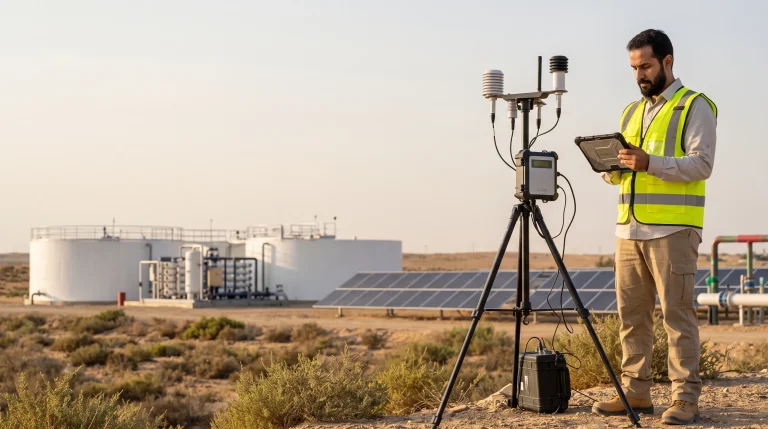
- Conducting field measurements
- Use certified instruments to monitor air, water, and soil quality.
- Record noise levels and gaseous emissions at different locations.
- Monitor affected wildlife and vegetation.
- Data analysis
- Compare field values against national and international standards.
- Assess any potential negative impacts on public health or the environment.
- Identify the main sources of risk.
- Interpreting results
- Provide clear recommendations to reduce environmental impact.
- Present practical, actionable solutions within the Environmental Management Plan.
- Use charts and tables to make results easier for the competent authorities to understand.
Following a clear methodology strengthens the report’s credibility and ensures that preparing environmental reports for government projects is not merely a formal routine, but an effective management tool.
Common mistakes that delay approval—and how to avoid them
Even large projects can face delays if certain details are overlooked:
- Failure to clearly document data sources.
- Using outdated or unapproved measurements.
- Neglecting analysis of impacts on natural habitats or local communities.
- Not including a follow-up plan and measurable performance indicators.
- Submitting a complex or poorly formatted report that is difficult for a government reviewer to follow.
To avoid these mistakes, do the following:
- Use reliable report templates.
- Maintain clear records of all measurements and analyses.
- Review the report internally before submission.
- Engage specialized consultants such as Al Buad Environmental to ensure quality.
Final checklist before submitting the report to the competent authority
Before submitting, verify the following points to help ensure acceptance without comments:
- Clearly define the project scope and the affected environment.
- Document all measurements and sources.
- Include all recommendations and operational procedures.
- Ensure all data are updated to reflect on-site reality.
- Review the report linguistically and technically to ensure clarity.
- Include tables and charts that facilitate understanding.
Following this checklist reduces the likelihood of rejection or requests for revisions, and makes preparing environmental reports for government projects a smooth, effective process.
Frequently Asked Questions
What is the difference between an Environmental Impact Assessment (EIA) and an Environmental Management Plan (EMP)?
An EIA identifies the expected impacts before the project begins, while an EMP explains how these impacts will be managed during implementation.
What are the key elements that any government environmental report should include?
Project description, affected resources, field data, impact analysis, mitigation recommendations, and a monitoring/follow-up plan.
Do measurements have to be conducted by an accredited entity?
Yes, to ensure the results are credible and acceptable to official authorities.
How often should environmental reports be updated for government projects?
Typically, updates are made periodically according to the timeline set in the EMP or as required by the relevant authority.
Environmental compliance in government projects is not only about meeting legal requirements—it is an indicator of management quality and responsibility toward society and the environment. Following best practices in preparing environmental reports for government projects ensures accurate, reliable reporting and reduces delays and legal risks.
If you are working on a government project and want a professional environmental report provides you with offers specialized expertise in data collection, analysis, report drafting, and review to help ensure fast acceptance by competent authorities—along with practical solutions to reduce environmental impact and achieve sustainability.
Want your report to be accepted the first time?
Reach out on WhatsApp and we’ll review your project report and identify any gaps before submission.
The content was reviewed by a team of environmental experts.
Environmental content at Al-Ba’ad Al-Bia’i Environmental Consulting Company is prepared and reviewed by a team of specialists in environmental studies, environmental impact assessment, environmental compliance, and environmental monitoring.
Meet the expert team