
 966535733690 +

Product transparency and Material Health Services
Preparation of declarations EPD And HPD For products and manufacturers
We help factories and suppliers to transform production records, material dataand supplier information into structured technical declarations and disclosures that can be reviewedand processed for verification, publication and use in specifications, tendersand green building projects.
The service includes the preparation of the environmental declaration of the product Environmental Product Declaration (EPD) Based on life cycle analysis, preparation of product material Health disclosure Health Product Declaration (HPD) Which organizes the information of the components and The Associated health risks, withData Quality Management, confidentiality and coordination with the competent external parties.
✓ Traceable data
✓ Organized management of suppliers
✓ Ready for verification and publication
✓ Support specifications and tenders
Direct answer
What is the difference between EPD And HPD؟
Focuses EPD The potential environmental impacts of the product duringthe phases of its life cycle based on the life cycle analysisand the applicable product category rules. As for HPD It focuses on the components of the product, the materials contained in it and The Associated health risk information. Each document can be prepared independently, or combined to providea more integrated package for product transparency.
EPD
It is not a quality mark or proof that the product is environmentally better in all cases.
HPD
It is not a safety certificate or proof that the product is risk-free.
Specialized service line
What are the services Transparency of products and authenticity of materials
These are technical tracks that help the factory organize and document environmentaland health data related to its products and turn them into standard disclosures that canbe used in front of developers, consultants, buyers, procurementand sustainability teams.
The work starts with identifying the product, target markets and disclosure path, thencollecting factory and supplier data, building a traceable evidence record, preparingtechnical documentation, quality review, and coordinating with verifiers orpublishing programs when applicable.
Why manufacturers invest in Product endorsements now
Environmental and health data is no longer just a marketing material; it has become partof technical qualification, specifications, sustainability, claims managementand product development decisions.
Qualifying for tenders
Major projects may require environmental documentation or product-specific component datawithin qualification tables and technical specifications.
Support for green buildings
The product documentation may support some requirements of building valuation systems, dependingon the version, type of product and the text of the actual requirement.
Identify opportunities to reduce impact
Life cycle analysis helps to find out which substances, processes and stagesare the highest contributors to environmental impacts.
Governance of allegations
Structured data supports the formulation of more accurate environmental and health claims and limitsthe use of unsupported statements.
Raising the confidence of specification setters
Consistent data gives design and procurement teams a better ability toreview the product and match it to project requirements.
Upgradeable system
The database can be reused when updating a product, changinga supplier, or adding new products and factories.
The difference between EPD And HPD
Each document answers a different question, and using them together provides a moreintegrated picture of environmental performance and product components.
| Comparison Aspect | EPD | HPD |
|---|---|---|
| Name | Environmental recognition of the product | Disclosure of the authenticity of product materials |
| Primary focus | Possible environmental impacts during the life cycle | Product contents and associated health risk information |
| Technical basis | Life cycle analysis, product category rules and impact assessment methods | Inventory of materials, components, identifiers and examination of risk information |
| Main data: | Materials, energy, water, transport, emissions, wasteand life cycle scenarios | Materials, components, concentrations, functions, impurities, supplier data |
| The main exit | An environmental declaration is prepared for verification and registration according to the applicable program | Standard disclosure of the authenticity of materials, with the possibility of optional verification when needed |
| Users | Procurement, developers, sustainability teams and life cycle analysis | Architects, designers, material health teams, manufacturers |
| What it does not prove | That the product is environmentally better than all other products | That the product is safe or risk-free in all uses |
| Value when combined | Identify environmental impact points and opportunities for improvement | Make the composition and risk information more transparent and auditable |
Not sure which document your product needs
Send the requirement for review
Submit a tender item or project requirement for review before determining the scope of the service.
Choose a service path Suitable for your product
We provide two specialized tracks for preparing environmental and health disclosures for products;the environmental declaration of a product focuses on its effects during the life cycle,while the material Health disclosure focuses on the components of the productand The Associated risk information.
EPD
The service is available
Preparation of the environmental declaration of the product
We help factories to prepare the environmental declaration of the product from the readiness assessmentand selection of product category rules, through data collection andlife cycle analysis, to coordination with the independent verification, registration and publication.
Product readiness assessment
Selection of product category rules
Collection of factory and supplier data
Preparation of life cycle analysis
Drafting of the EPD report and approval
Coordination with verification and publication
What does EPD explain
View service details
EPD
Possible environmental impacts of the product during the stages of its life cycle,the use of resources, energy, water and waste flows.
HPD
The service is available
Preparation of product material authenticity disclosure
We help factories prepare product material Health disclosure from defining the scopeof disclosure and inventory of materials and components, to managing suppliers ' data, confidential formulations, checking risk information and preparing the document for reviewand publication.
Determining the scope and disclosure limit
Inventory of materials and components
Supplier data management
Protection of secret installations
Checking risk information
Preparation for review and publication
What does HPD explain
View service details
HPD
The components of the product, the substances contained in it, their concentrations, functionsand associated health risk information.
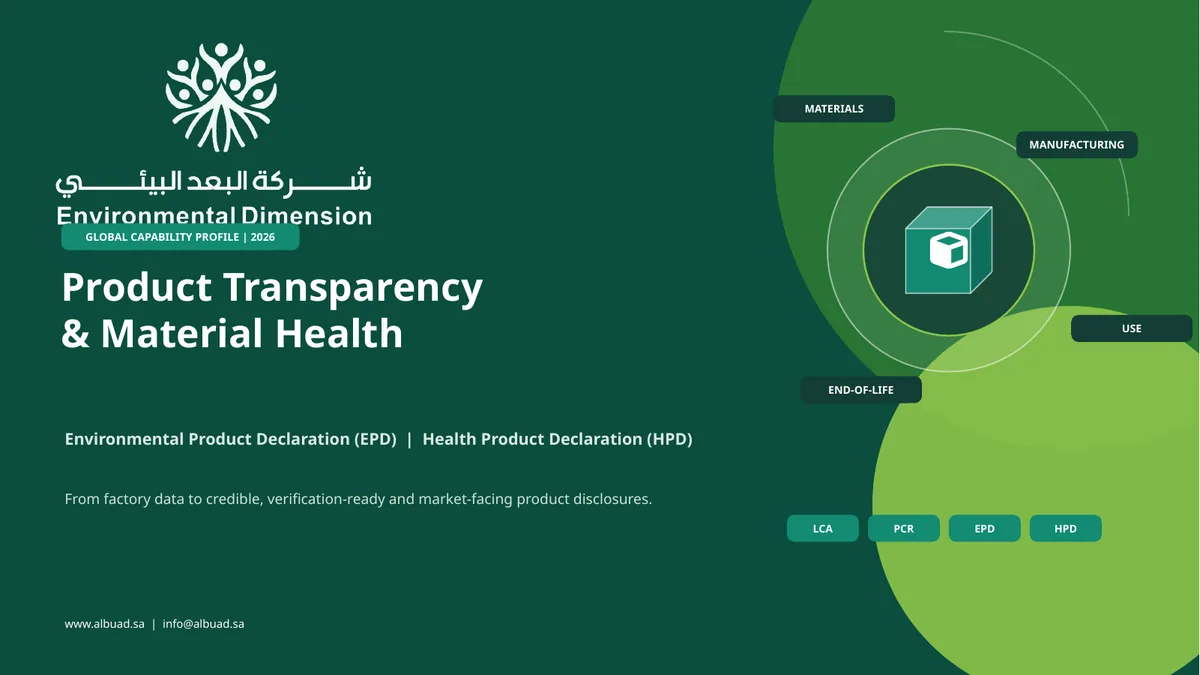
Global dating profile 2026
Get to know our capabilities in Transparency of products and preparation EPD And HPD
Review the full profile of product transparency and materials authenticity services,which explains the environmental dimension company's methodology in converting factoryand supplier data into structured technical disclosures ready for review, verification, publicationand use in specifications and tenders.
33
Page
2026
Release
English
File language
PDF
File format
Product transparency strategy
Preparation and analysis of the life cycle
EPD environmental Declaration Service
HPD material Health disclosure service
Factory and supplier data management
Preparation for verification and publication
The file includes technical and commercial information aimed at manufacturers, suppliers, developers, consultants, procurement and sustainability teams.
A single database And multiple market outputs
Instead of re-collecting data from scratch for each order, we build a structuredfoundation that can be used for disclosures, tenders, product improvement plans, and managingupdates.
Product transparency database
Controlled data and traceable evidence
EPD
Life cycle model and environmental validation
HPD
Product ingredients and risk information
Tender file
Executive summary and index of evidence
Product improvement
Impact points, scenarios and actions
Change management
Annual updates, new products and renovations
Eight stages of readiness To activate in the market
The project is based on clear review points that maintain the visibilityof technical decisions, data responsibilities and a record of evidence throughout the implementation period.
Readiness assessment
Review the product, commercial objective, target markets, customeror project requirements and data availability.
Defining the scope and approach
Identification of products, factories, study limits, disclosure level, verification and publication path.
Data and evidence collection
Collection of production data, materials, energy, suppliers, transportation, packaging, waste and supporting documentation.
Build a product database
Organize the input and link each statement to a source, record, or assumption that can be trackedand reviewed.
Technical preparation
Preparation of sample life cycle and documentation EPD Or list the materialsand check information HPD.
Internal audit
Review completeness, consistency, assumptions, versionsand supporting documentation before external transmission.
Coordination with verification
Manage questions, comments and amendments with the competent thirdparty when verification is applicable.
Deployment and activation
Preparing the final version, tender summaries, maintenance plan, updatingand taking advantage of the results.
Adopt the goal, scope and list of products.
A traceable data package is completed.
Review the form and draft internally.
The applicable verification or deployment path is completed.
What data does the plant need To prepare it
The final list of data varies depending on the type of Product, Program rulesand target market, but the basic evidence structure remains close.
Factory and operation data
- Annual production volumes and loss ratios.
- Electricity, fuel and heat consumption.
- Water consumption.
- Direct emissions when associated with the range.
- Waste and treatment methods.
- The map of processes and the basis of personalization.
- Quality and environmental records.
Product data and packaging
- Product function and specifications.
- List of materials and quantities.
- Recycled or bio-based content.
- Installation of packaging materials.
- Accessories and installation requirements.
- Use, maintenance and operational life.
- End-of-life scenarios.
Suppliers and logistics
- Supplier data and country of origin.
- Means and distances of internal transportation.
- Scenarios of external distribution.
- Representations and statements available for materials.
- Sheets and data of technical materials.
- Composition guides and concentrations.
- Confidentiality and data ownership restrictions.
Data quality
=
Completion
+
Consistency
+
Time
+
Location
+
Technique
+
Traceability
Data protection
How to protect secret compositions And supplier data
Products may include special formulations, trade secrets or datathat the supplier does not want to share directly with the manufacturer. Confidentiality is therefore administered as partof the disclosure methodology, and is not a reason to leave the list of materials or evidence unchecked.
Non-disclosure agreements
A safe space for file sharing
Direct submission from the supplier
Control of access permissions
Allowed public IDs
Suitable concentration ranges
A record of unclosed gaps
Separation of secret appendices
Supporting green building requirements Specifications and tenders
We review the text of the requirement, the version of the order and the type of product before confirming the eligibilityof the document or its contribution to any contractual clause, point or condition.
Environmental product documentation and material component information according to project requirements.
Transparency of health-related materials and documents depending on the applicable route and version.
Evidence of environmental performance of materials and responsible supply according to project requirements.
Regional or project-specific documents for materials and environmental performance.
Required schedules of products, declarations, manuals and delivery dates.
Review product requirements and prepare a deliverable summary and index of evidence.
Supported products and sectors Within the program
Cement and concrete
Iron, aluminum, metal
Glass, gypsum, insulation
Paints, flooring and adhesives
Timber, doors, composite materials
Plastic packaging and membranes
HVAC products and extensions
Furniture and interior design products
Renewable energy technologies
Chemical and specialized materials
Medical and laboratory products
Industrial equipment and systems
What does the factory receive Within the project
A structured basis for both tracks
- Readiness and gap assessment report.
- Note the product scope and disclosure path.
- A data collection form and a record of evidence.
- An organized database of the product.
- Record questions, gaps and versions.
- Executive summary of management.
- A summary is suitable for the tender or sales team.
- Modernization and maintenance plan.
Environmental recognition outputs
- Life cycle modeling and analytics.
- Life cycle analysis project report.
- Draft acknowledgement and final version.
- Record responses and edits.
- Registration and publishing package.
- Analysis of impact points.
- Map product improvement opportunities.
- A confidential data supplement when needed.
Material validity disclosure outputs
- List of materials and components.
- Record substances, concentrations and functions.
- Record evidence and responses of suppliers.
- The results of the risk information check.
- Structured data for the preparation of disclosure.
- Draft disclosure for review.
- Package guides for optional verification.
- Plan an update when the composition or supplier changes.
Start with one product or son Product portfolio software
Single product launch
Suitable for a priority product, an urgent requirement of a tender or a specific project.
- Assessment of readiness.
- EPD Or HPD Or both.
- Coordination with verification.
- Summary of the tender.
Product family program
Suitable for converging products, several storage units or factories.
- Product family strategy.
- Rules for determining differences.
- A common data model.
- Several representations or disclosures.
- Quality assurance and updating plan.
An integrated transparency platform
Suitable for manufacturers who frequently receive disclosure requests.
- Master engineering of product data.
- A system for communicating with suppliers.
- A continuous course of preparation EPD AndHPD.
- Indicator panels and renovations.
- A program for improving products.
Local expertise and methodologies Internationally usable disclosure
Understanding the Saudi market
Linking product requirements to the reality of factories, purchases and projects within the kingdom.
Integration of Environmental Services
Linking disclosures to life cycle analysis, carbon footprint, sustainabilityand compliance.
Understanding of industrial sectors
A practical application that suits building materials, industrial, chemical and technical products.
Structured data management
Clear forms, specific responsibilities, a record of evidence, observations and releases.
Applicable methodologies and rules
Choose the appropriate standards, product category rules and program requirements foreach project.
Stakeholder coordination
Dealing with production, quality, sustainability, procurement, suppliersand verifiers.
Important professional clarification
What is the role of the environmental dimension company and what is the role of the verification authority
The environmental dimension company evaluates readiness, defines scope, collectsand organizes data, prepares studies and technical documentation, reviews Quality,coordinates with interested parties. Independent verification, registration, publicationor issuance of any final accreditation is carried out by the competent third parties in accordancewith the program and the applicable standard.
Does not represent a preparation process EPD Or HPD Eligibilityis subject to the requirements of the project, the final document and the decision of the entityresponsible for evaluation or procurement.
Questions about services EPD And HPD
Is the environmental declaration of the EPD product an environmental certificate
No longer EPD A quality mark or a certificate of success and failure, but rather an acknowledgementthat displays information about the potential environmental impact of the product accordingto a specific methodology and rules, and is subject to a verification and registration path according to the applicable program.
Does HPD disclosure prove that the product is safe
No.no. Displays HPD The components of the product and The Associated risk information, but it does not represent a complete assessment of exposure or risk and does not prove thatthe product is safe or risk-free in every use.
What is the difference between LCA and EPD life cycle analysis
Lifecycle analysis is the technical basis by whichproduct lifecycle data is collected and analyzed, while EPD It is a structured documentthat displays the results according to the rules of the product category and the requirements of the applicable publishing program.
Does the product need EPD and HPD together
It depends on the requirements of the market, the customer or the tender. He may ask EPD Only, or HPD Only, or the two documents togetherto offer a more integrated package for product transparency.
Does environmental dimension company issue EPD and HPD certification or accreditation
The company prepares data, studies, documents, technical coordination. Independent verification, registration, publication or any final approvalshall be handled by the competent third parties according to the applicable program.
Can EPD be set up for a family of products or several factories
This can be studied according to the program rules, the product category, the similarityof products and processes, and the possibility of clearly documenting the differences between products ormanufacturing sites.
What happens when supplier data is lacking
Communication with suppliers is organized, gaps are documented, optionsallowed by the methodology are studied, the impact of unavailable orestimated data on the completeness and quality of the results is clarified.
Can secret combinations be protected
Confidentiality agreements, protected transmission paths, confidential appendices, access permissions and disclosure methods allowed by the system used can be used, while preservingthe evidence required for review.
How long does it take to set up EPD or HPD
The duration varies depending on the complexity of the product, the number of products, factories and suppliers,the availability of data, the speed of closing gaps, the required verification or deployment path.
What data is required to get an art show
It is preferable to provide the name of the product and its category, the number of products and factories,the target market, the reason for the order, the tender file or the project requirement, the availabilityof the list of materials, production data and suppliers.
Quality and reliability
Content and service based on role separation and data traceability
The final curriculum, product category rules, deployment program, disclosure limits and verification requirements are determined for each project after reviewing the product, target market and actual requirement.
Content preparation: product transparency and sustainability team
Technical review: quality and technical governance department
Scope of service: Saudi Arabia and international markets according to the project
Last review: August 2026
Start with a decision based on actual data readiness
Order a product readiness assessment
Is your product ready to prepare EPD Or HPD؟
Submit the product data and project or tender requirements, we will review theproduct range, availability of factory and supplier data, appropriate verification and publication pathbefore preparing the technical offer.
The content was reviewed by a team of environmental experts.
Environmental content at Al-Ba’ad Al-Bia’i Environmental Consulting Company is prepared and reviewed by a team of specialists in environmental studies, environmental impact assessment, environmental compliance, and environmental monitoring.
Meet the expert team