 966535733690 +

Environmental risk management in Saudi schools: An integrated service for assessing and monitoring the school environment

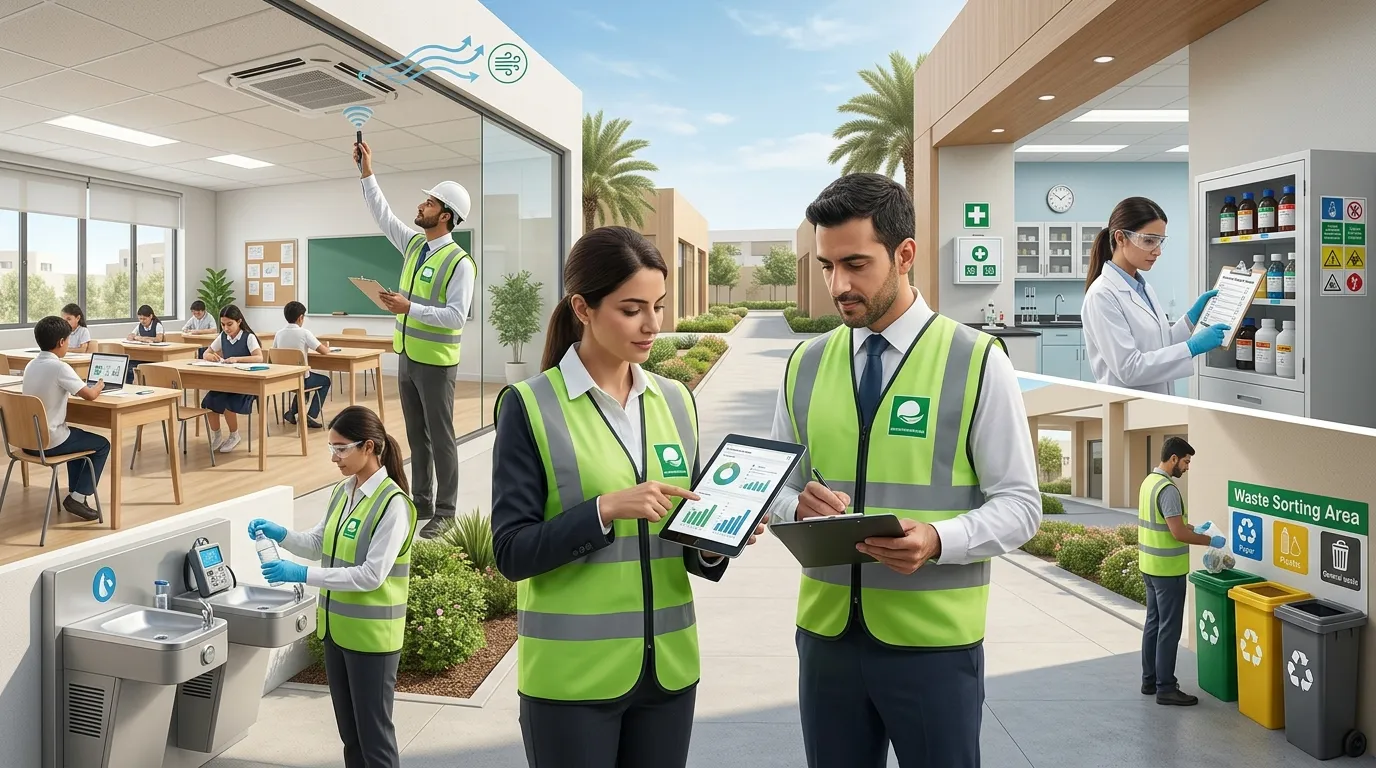
It is Environmental risk management in schools This is an important topic for any educational institution seeking to provide a healthy and safe environment for students, teachers, and administrators. A school is not just classrooms, but an operational system that includes classrooms, laboratories, canteens, toilets, tanks, courtyards, warehouses, air conditioning and ventilation systems, waste areas, and electrical and emergency facilities.
Environmental hazards in schools sometimes manifest indirectly; such as poor ventilation, high temperatures inside classrooms, dampness behind walls, undocumented and uncleaned water tanks, and improper storage of chemicals in laboratories, Or the accumulation of waste attracts pests. Therefore, it is not enough to rely on outward cleanliness alone; there must be a system of evaluation, monitoring, documentation, and continuation.
Environmental Dimension helps schools, educational complexes, and facility management companies assess the school environment. Identifying risks, preparing an environmental risk register, developing a corrective action plan, and designing a periodic monitoring program appropriate to the nature of each educational facility, while emphasizing that the final requirements vary according to the type of school, its location, its facilities, and the supervising bodies
Direct answer: Environmental risk management in schools is a systematic process of identifying and monitoring risks that may affect the quality of the school environment, such as indoor air quality, drinking water, ventilation, temperature, humidity, mold, waste, Chemicals, pests, and emergencies. It aims to transform the school from a reactive management system to a proactive system based on inspection, documentation, correction, and continuation.
Table of Contents
- What is environmental risk management in schools?
- Why do schools need a regular environmental program?
- What facilities are included in the school's environmental assessment?
- Indoor air quality and ventilation assessment
- Thermal comfort and temperatures within the seasons
- Assessment of drinking water quality and water networks
- Managing mold and humidity within educational buildings
- Chemicals Management and School Laboratories
- School waste and backyard management
- Pest management within schools
- Environmental cleanliness and maintenance
- Power outages, energy disruptions, and damage to critical facilities
- Environmental and Climate Risk Emergency Plan
- Steps for implementing the service from Environmental Dimension Company
- Who is this service suitable for?
- Information, trust, and transparency
- Frequently Asked Questions
What is environmental risk management in schools?
Environmental risk management in schools is a technical service that aims to examine the school environment and identify sources of environmental, health and operational hazards within school facilities, and then develop practical procedures to control and monitor them over time.
The service answers four basic questions:
- What environmental hazards exist within the school?
- Where exactly are these risks located?
- What are the appropriate corrective and preventive measures?
- How can these risks be monitored and prevented from recurring?
What are the service outputs?
- Environmental assessment report for school facilities.
- Record environmental risks by location and priority.
- A risk classification matrix based on severity and probability.
- CAPA Corrective Action Plan.
- A program for periodic monitoring of air, water, humidity, waste, and chemicals as needed.
- Inspection lists for supervisors and school administration.
- Record templates for training, maintenance, accidents and complaints.
- Practical recommendations for improving school environment management.
Why do schools need a regular environmental program?
Schools are daily environments where a large number of students and staff are present for extended periods. Therefore, minor environmental problems can recur daily and affect the quality of the learning environment if not detected early.
The danger may begin with a simple water leak leading to dampness and mold, a dirty air conditioning filter that reduces air quality, a laboratory containing expired materials, or an unorganized waste area that attracts pests. Over time, these details turn into larger operational gaps.
Objectives of the Environmental Risk Management Program
- Early detection of sources of danger within the school.
- Improving air quality and ventilation inside classrooms.
- Improving the reliability of drinking water and cooling points.
- Reduce the risk of mold and dampness.
- Organization of laboratories and chemicals.
- Improving waste and pest management.
- Improving the school's preparedness for environmental and climate emergencies.
- Providing clear records helps management to follow up.
This service can be linked within a broader service framework.
Environmental compliance in Saudi Arabia
When an educational institution needs an ongoing monitoring program.
What facilities are included in the school's environmental assessment?
Environmental assessment of a school should not be limited to classrooms only, but should include all areas that may affect the health and safety of the educational environment. The scope of the inspection varies depending on the size of the school, the age of the building, the number of students, the presence of laboratories or canteens, and the air conditioning and ventilation system.
| Attachment | What is being checked? |
|---|---|
| classrooms and halls | Ventilation, heat, lighting, noise, odors, humidity, and filter cleanliness. |
| laboratories | Chemicals, storage, SDS, ventilation, spillage equipment, and hazardous waste. |
| Cafeteria and dining areas | Hygiene, food storage, pest control, waste, and temperature. |
| Toilets and washrooms | Leaks, odors, drainage, cleanliness, ventilation, and sources of moisture. |
| Water tanks and drinking points | Tank cleaning, shut-off, filters, coolers, and maintenance or cleaning records. |
| Squares and stadiums | Shading, dust, heat, water accumulation, and physical hazards. |
| warehouses | Ventilation, humidity, storage, old materials, cleanliness, and pest control. |
| Air conditioning and ventilation systems | Filters, air ducts, return air, humidity, and maintenance schedule. |
| waste areas | Containers, location, odors, lifting frequency, and sources of pest attraction. |
| Bus and car parking | The effect of exhaust fumes, their proximity to air intakes, and the regulation of movement. |
Indoor air quality and ventilation assessment
Indoor air quality is one of the most important aspects of environmental risk management in schools, because students spend long hours inside classrooms and halls. Air quality may be affected by factors such as poor ventilation, dust accumulation, poor filter maintenance, odors, humidity, or the proximity of car and bus exhaust sources to air intakes.
What is being checked?
- The efficiency of natural or mechanical ventilation within classrooms.
- Condition of air conditioning filters and schedule for replacing or cleaning them.
- The presence of persistent odors or stagnant air in some areas.
- Dust sources include yards, maintenance work, or false ceilings.
- Bus stops are close to fresh air outlets.
- Indicators of humidity or mold that may affect air quality.
- The need for field measurements such as CO, PM2.5 or PM10 depending on the technical situation.
Fixed monitoring devices should not be installed in every school as a general requirement without prior assessment. Ideally, the type of measurement should be determined based on the complaint, the building's characteristics, the ventilation system, and the identified hazards.
Thermal comfort and temperatures within the seasons
Thermal comfort inside classrooms affects the quality of the learning environment, especially during the summer months or in buildings with poor air conditioning, insulation, or air distribution. The problem may appear in some seasons but not others due to the direction of the sun, the height of the ceiling, poor insulation, or poor distribution of air conditioning vents.
Evaluation procedures
- Identify the seasons or sectors that suffer from high temperatures.
- Check the performance of the air conditioning units or central system.
- Review the air conditioning preventive maintenance schedule.
- Measure temperature and humidity at different times as needed.
- Evaluation of external shading and thermal insulation of roofs and facades.
- Providing practical recommendations to improve air distribution and reduce heat load.
Assessment of drinking water quality and water networks
Evaluating drinking water in schools involves more than just confirming its presence; it includes inspecting tanks, drinking points, coolers, filters, pipes, leaks, and stagnant water. This inspection process must be based on clear and accurate records and periodic reviews
What does the Environmental Dimension company examine?
- Ground and overhead tanks in terms of cleanliness, closure and ventilation.
- Condition of drinking taps, coolers and filling points.
- Filters and their replacement or maintenance schedule.
- The presence of leaks or stagnant water around drinking points or toilets.
- The condition of the visible pipes and indicators of corrosion or deposits.
- The need to take samples and perform bacterial or chemical analyses, depending on the case.
- Having a backup plan in case of water outages or supply network failure.
Water monitoring program
- A cleaning and disinfection schedule for the tanks, according to the requirements of the supervising authority or the school plan.
- Documenting the maintenance of filters and coolers.
- Record complaints related to taste, smell, or color.
- Appointing a person responsible within the school to monitor drinking points.
- Documenting the results of examinations and analyses when they are performed.
Managing mold and humidity within educational buildings
Dampness and mold are risks that can start small and then expand if the source of the water or ventilation is not addressed. Dampness can appear as a result of leaks in ceilings, pipes, bathrooms, and air conditioning units, or condensation due to poor ventilation.
Steps for checking for mold and moisture
- Check the walls, ceilings, corners, and areas behind furniture.
- Identify damp patches, mold odors, or signs of condensation.
- Inspect the toilets, washbasins, and drainage lines.
- Measure the moisture content in materials or air when needed.
- Identify the root cause: leakage, condensation, poor ventilation, or faulty insulation.
- Prepare a record of affected areas and their priority.
Prevention and treatment plan
- Repair the source of the leak before any surface treatment.
- Clean the affected areas using safe and appropriate methods.
- Improve ventilation or air conditioning distribution when needed.
- Avoid storing paper or cardboard in humid areas.
- Re-examine after treatment to ensure the problem does not return.
Chemicals Management and School Laboratories
School laboratories require special care because they may contain chemicals, glassware, heating equipment, and waste that needs to be sorted, stored, and managed. The school should not rely solely on having materials inside cabinets, but on a clear inventory, storage, and training system.
Assessment criteria in laboratories
- Prepare a complete inventory of the chemicals.
- Identify expired or unused materials.
- Review the method for separating incompatible materials.
- Providing SDS safety data cards for critical materials.
- Inspect the ventilation inside the laboratory and storage areas.b
- Providing tools for dealing with spills when needed.
- Training laboratory personnel on initial response.
- Establish a mechanism for collecting chemical and glass waste.
Schools with active laboratories can benefit from the service
Chemical Safety Consulting in Saudi Arabia
To organize storage, inventory, and spill response.
School waste and backyard management
Waste management within schools includes classrooms, cafeterias, offices, laboratories, playgrounds, and backyard collection areas. Unsealed containers or improper collection locations can lead to odors, attract pests, or cause operational issues.
What should be reviewed?
- Container locations inside and outside the school.
- Regular waste collection and removal.
- Separate general waste from any special or laboratory waste.
- Keeping collection areas clean and preventing liquids from accumulating.
- The presence of odors or signs of pests around the containers.
- Educating students and staff on how to dispose of waste.
- Document contracts or arrangements for waste transfer when necessary.
This axis can be linked to a service
Waste Management and Waste Reduction
When a more organized plan is needed.
Pest management within schools
Pest management in schools does not mean relying solely on pesticides, but rather it must rely on a preventive approach that identifies the cause of the pest's appearance, the source of food or water, entry points, and hiding areas. This is known as Integrated Pest Management (IPM).
Components of a pest management program
- Regular inspections of food, waste, and warehouse areas.
- Seal openings, cracks, and sources of pest entry.
- Improve hygiene and reduce food and water sources.
- Using safe and appropriate solutions for the nature of the school.
- Organize any counter-terrorism operations in a way that does not endanger students.
- Documentation of control activities, notifications, and records.
- Training cleaning and maintenance workers to detect early signs.
Environmental cleanliness and maintenance
Cleaning and maintenance products affect indoor air quality and overall safety within the school. Therefore, cleanliness should not be assessed only in terms of appearance, but also in terms of the materials used, the method of storage, the quality of ventilation during use, and protecting students from access to materials.
What is being evaluated?
- Type of cleaning and disinfectant products used.
- Storage areas for cleaning materials and their sealing.
- Students were prevented from accessing chemicals.
- A method for cleaning dust without redistributing it in the air.
- Cleaning records for sensitive facilities such as restrooms and cafeterias.
- Preventive maintenance for air conditioning, plumbing, and warehouses.
- Training cleaning staff on how to handle materials and spills.
Power outages, energy disruptions, and damage to critical facilities
Power outages in schools can affect air conditioning, ventilation, water coolers, cafeterias, lighting, and some laboratory equipment. Therefore, this should be included in risk assessments and emergency plans, especially in schools with high student density or large buildings
Assessment criteria
- Identifying the sensitive facilities affected by the power outage.
- Check the readiness of backup generators, if available.
- Check the maintenance records of generators or alternative energy sources.
- Determine the impact of the outage on air conditioning, drinking water, and the cafeteria.
- Include a power outage scenario in the school's emergency plan.
Environmental and Climate Risk Emergency Plan
Environmental emergencies in schools include situations such as sandstorms, heat waves, water leaks, chemical spills in laboratories, strong odors, water pooling, or power outages. The plan must be clear and appropriate to the school's capacity to implement it.
Components of an environmental emergency plan
- A record of potential environmental emergencies.
- Defining the response team and its responsibilities.
- Procedures for dealing with sandstorms and heat waves.
- Procedures for dealing with leaks or spills.
- A plan for internal communication with management, teachers, and parents when needed.
- Evacuation points or temporary isolation depending on the type of hazard.
- Training records and practical exercises when needed.
Steps for implementing the service from Environmental Dimension Company
Environmental Dimension Company relies on a practical methodology that begins with field inspections and ends with an actionable follow-up plan. Not all schools are treated the same way; The service is tailored according to the age of the building, the type of school, the number of students, the facilities, and the risks present.
First step: Initial field assessment
Visit the school and inspect the main facilities, such as classrooms, laboratories, toilets, canteen, water tanks, air conditioning, warehouses, courtyards, and waste areas.
Step two: Documenting the risk record
Prepare a record that identifies each risk, its location, priority level, likely cause, and proposed action.
Step three: Gap analysis
Comparing the current situation with what a school environmental management system should be, such as having records, maintenance, follow-up, training, and emergency plans.
Step four: Preparing the corrective action plan
Identify the required actions, responsibilities, priorities, and timelines, while distinguishing between urgent and improvement actions.
Step five: Follow up and close the notes Prepare a record that identifies each risk, its location, priority level, likely cause, and proposed action.
Conduct follow-up visits or periodic reviews to verify the implementation of procedures and update the risk log based on the results.
Who is this service suitable for?
- Public schools.
- Private and international schools.
- Kindergartens and nurseries.
- Large educational complexes.
- Educational facility management companies.
- Operations and maintenance departments in educational institutions.
- Schools that suffer from frequent complaints related to air, water, humidity, or cleanliness.
- School chains that need a standardized assessment model for comparing branches.
Information, trust, and transparency
This article was prepared to explain the Environmental Risk Management Service in schools in a professional manner, while avoiding undocumented claims such as guaranteeing the complete closure of all observations, Or generalize certain monitoring requirements to every school, or say that all schools are directly subject to the same requirements as industrial facilities.
- Experience: The article focuses on real-world environmental hazards within schools, such as air, water, mold, laboratories, waste, pests, and emergencies.
- Jurisdiction: The article explains the difference between an environmental assessment, a risk register, a corrective action plan, and a monitoring program.
- Reliability: The article makes no promises of guaranteed health or regulatory outcomes, but rather outlines a practical framework for assessment and improvement.
- Transparency: The role of the Environmental Dimension Company is to provide technical and advisory support, while the final requirements vary depending on the type of school, the supervising authorities, and the condition of the building.
Frequently asked questions about environmental risk management in schools
What is meant by environmental risk management in schools?
It is a systematic inspection and monitoring process of school facilities to identify environmental hazards such as air quality, water, heat, humidity, mold, pests, chemicals, waste, and emergencies, and then to develop and implement procedures to control and monitor them.
Does the environmental assessment service only cover classrooms?
No. A good assessment includes classrooms, laboratories, canteens, toilets, tanks, courtyards, warehouses, electrical rooms, waste areas, air conditioning and ventilation systems, and the school's external perimeter.
How does the service contribute to improving air quality inside classrooms?
By examining ventilation, air conditioning, filters, sources of dust, odors, and humidity, then determining appropriate actions such as improving maintenance, cleaning filters, treating humidity, or taking measurements when needed.
Should air quality monitoring devices be installed in every school?
Not necessarily. The need for equipment or measurements is determined based on the condition of the building, complaints, ventilation system, presence of pollution sources, or supervisory authority requirements.
What is the mechanism for managing chemicals in school laboratories?
It begins with inventorying materials, reviewing storage and compliance, providing SDS, excluding damaged or unused materials, preparing spillage tools, and determining a mechanism for the safe disposal of chemical and glass waste.
How are mold and dampness issues dealt with in schools?
First, the source of the moisture or leak is identified, then the affected areas are cleaned appropriately, ventilation or insulation is improved where needed, and then a re-inspection is performed to ensure the problem does not recur.
Can the program be implemented in several schools?
Yes, a standardized assessment model can be developed for a chain of schools or educational complexes, with a risk record created for each school and priorities compared between branches to determine a centralized improvement plan.
What is the relationship between environmental risk management and the emergency plan?
The risk register helps identify potential emergency scenarios such as sandstorms, heat waves, leaks, power outages, or chemical spills, and then translate them into clear response actions.
Is the service a substitute for daily maintenance and cleaning?
No. The service does not replace maintenance and cleaning teams, but it helps to assess the quality of these works, identify gaps, and establish a system for monitoring, recording, and corrective actions.
How does the Environmental Dimension Company help schools?
Environmental Dimension Company helps in inspecting school facilities, preparing a risk register, assessing air, water, humidity, laboratories and waste, developing a corrective plan, and designing a periodic follow-up program appropriate to the school environment.
Conclusion
Represent Environmental risk management in schools This is an important step towards transforming the school environment into a more organized and protective system. Environmental hazards are not always readily apparent, but they can begin with a small leak, a dirty filter, or a tank that has not been properly cleaned, Or a chemical substance stored improperly.
Having an assessment and monitoring program helps the school administration understand risks, prioritize, document procedures, and practically monitor improvements. The more a program is tailored to the nature of the school and its facilities, the more beneficial it will be in supporting a healthy and safe learning environment.
Contact Environmental Dimension Company to obtain a comprehensive environmental assessment of your school or educational complex, and to prepare a risk record and follow-up plan that will help you improve the quality of the school environment.
The content was reviewed by a team of environmental experts.
Environmental content at Al-Ba’ad Al-Bia’i Environmental Consulting Company is prepared and reviewed by a team of specialists in environmental studies, environmental impact assessment, environmental compliance, and environmental monitoring.
Meet the expert team