 966535733690 +


Environmental Permit for Workshops and Activities

Obtaining an environmental permit for workshops has become a fundamental step to ensure business continuity and protect the project from violations and fines. Many workshop owners discover too late that the absence of a permit or non-compliance with environmental requirements can result in a complete shutdown of operations. Here comes the role of Al-Bouad Environmental Company, which provides practical and integrated solutions for issuing permits and organizing workshops in an environmentally compliant manner. In this article, you will learn why workshops are treated as a special case, what the actual requirements are, and how to prepare your workshop for inspection with confidence and safety. Follow this comprehensive guide to the end to learn everything you need to know about obtaining an environmental permit for workshops.
Table of Contents:
- Why are workshops treated as a special environmental case?
- Sources of environmental impact in workshops (oils/paints/solvents/noise)
- Storage and waste disposal requirements
- Ventilation, emissions, and odors: how to control them
- Workshop inspection readiness: a practical checklist
- Common workshop violations and how to avoid them
Why are workshops treated as a special environmental case?
تختلف الورش بيئيًا عن كثير من الأنشطة التجارية، ولهذا تتطلب Environmental Permit Workshops differ environmentally from many other commercial activities; therefore, they require an environmental permit for workshops under specific and detailed conditions. Key reasons include:
- Workshops combine multiple activities such as maintenance, painting, and operation—each with a different environmental impact.
- The use of oils and chemicals increases the risk of contamination compared to regular service activities.
- Workshops are often located near residential areas, increasing sensitivity to noise and odors.
- Workshop waste may be hazardous if not handled properly.
- Air emissions from painting or welding operations require special monitoring.
- Environmental authorities classify workshops among activities that require an environmental operating permit prior to commencement.
- Any expansion or modification of workshop activities may require updating the environmental permit.
- The presence of heavy equipment increases the risk of leaks or spills.
- Workshop inspections are periodic and more detailed.
- Environmental compliance enhances the workshop’s reputation with customers and regulatory authorities.
Request preparation of your workshop permit file via WhatsApp
Sources of environmental impact in workshops (oils/paints/solvents/noise)
To understand the requirements for an environmental permit for workshops, it is essential to identify the primary sources of environmental impact within the workshop, including:
- Used oils generated from engine and machinery oil changes.
- Paints and varnishes that release volatile organic compounds (VOCs).
- Solvents used for cleaning and degreasing.
- Noise generated by equipment, compressors, and hammers.
- Used oil and air filters.
- Fumes generated from welding operations.
- Wastewater contaminated with oils.
- Empty chemical containers.
- Dust resulting from sanding and cutting.
- Vibrations that may affect the surrounding environment.
Storage and waste disposal requirements
Safe storage and proper waste disposal are key components of obtaining an environmental permit for workshops. To ensure compliance, the following must be observed:
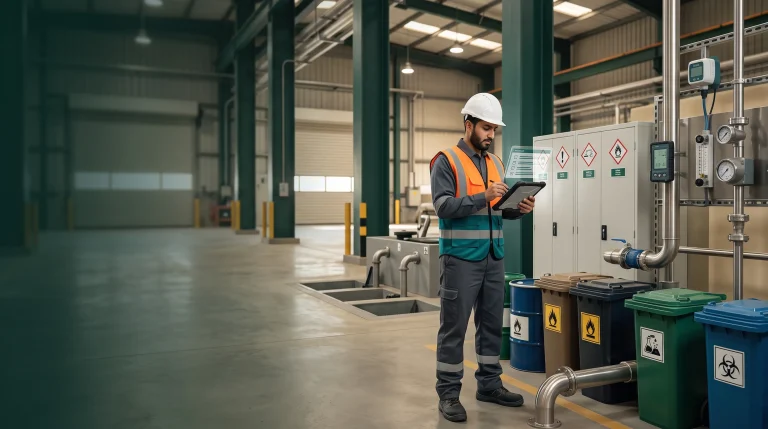
- Designate a clearly defined and enclosed area for storing used oils.
- Use tightly sealed, leak-resistant containers.
- Separate hazardous waste from non-hazardous waste.
- Place identification labels on all containers.
- Avoid storing waste near heat sources.
- Contract with an approved waste transport entity.
- Maintain waste transfer and disposal records.
- Prevent random disposal or discharge into sewage systems.
- Clean any spills immediately upon occurrence.
- Comply with the environmental operating permit instructions approved by the competent authority.
Ventilation, emissions, and odors: how to control them
Air quality control within the workshop is a fundamental requirement for obtaining an environmental permit for workshops. This can be achieved by:
- Installing appropriate mechanical ventilation systems.
- Using filters to capture fumes and paint particles.
- Isolating painting areas from the rest of the workshop.
- Conducting periodic maintenance of exhaust fans.
- Minimizing the use of highly volatile materials whenever possible.
- Directing air outlets away from nearby residential areas.
Workshop inspection readiness: a practical checklist
Before any inspection visit, ensure that your workshop is ready and compliant with the environmental permit for workshops by reviewing the following checklist:
- A valid copy of the environmental permit is available on-site.
- Clear overall cleanliness within the workshop.
- Proper storage of oils and chemicals.
- Updated waste disposal records.
- Safety equipment is available and in good condition.
- Ventilation systems are operating efficiently.
- No leaks or spills are present.
- Workers comply with safety procedures.
- Clear movement pathways within the workshop.
- The actual activity matches what is stated in the environmental operating permit.
Common workshop violations and how to avoid them
Many workshops incur fines due to easily avoidable mistakes, especially when failing to comply with the environmental permit for workshops or neglecting consultation with a specialized firm such as Al-Bouad Environmental. The most common violations include:
- Disposing of used oils into the sewage system.
- Storing waste in unsuitable containers.
- Operating without a valid environmental permit.
- Ignoring excessive noise levels.
- Absence of waste management records.
- Failure to maintain ventilation systems.
- Using unauthorized materials.
- Expanding activities without updating the permit.
- Not training workers on environmental requirements.
- Ignoring previous inspection remarks.
Frequently Asked Questions:
Do car workshops require an environmental permit?
Yes. Car workshops are among the activities most in need of an environmental permit due to oils, noise, and emissions.
What is the proper way to handle used oils?
They should be collected in tightly sealed containers and handed over to a licensed entity, with official documentation retained.
Are there requirements for washing parts or engines?
Yes. Discharging contaminated water directly is prohibited, and oil separation measures must be implemented.
How can I reduce the risk of violations during inspection?
By fully complying with the conditions of the environmental operating permit and cooperating with a specialized environmental consultancy firm.
Finally, compliance with the requirements of an environmental permit for workshops is not a burden but an investment in the stability of your business. Contact Al-Bouad Environmental today to receive professional support that ensures safe and environmentally compliant operations.
Send us your workshop activity, and we will provide you with an inspection readiness checklist.
The content was reviewed by a team of environmental experts.
Environmental content at Al-Ba’ad Al-Bia’i Environmental Consulting Company is prepared and reviewed by a team of specialists in environmental studies, environmental impact assessment, environmental compliance, and environmental monitoring.
Meet the expert team