
A wastewater result cannot be reduced to simply "compliant" or "non-compliant." BOD, COD, TSS, and TDS each describe a different aspect of water characteristics, pollutant load, and process or treatment plant performance. When these indicators are read alongside flow, production, and operating conditions, they transform from isolated laboratory numbers into practical tools for detecting changes and investigating their causes.
Direct answer: BOD measures a fraction of the biodegradable organic load, COD describes a broader range of chemically oxidizable materials, TSS relates to suspended solids, and TDS reflects dissolved solids. Correct interpretation does not rely on a single number; rather, it depends on the sampling point and type, flow, facility activity, treatment performance, temporal trend, and applicable reference.
What is the difference between BOD, COD, TSS, and TDS?
| Index | What does it generally show? | What might it help diagnose? |
|---|---|---|
| BOD | Biodegradable organic load under specific test conditions. | Changes in biodegradable organics and biological treatment performance. |
| COD | Chemically oxidizable load in the sample. | Rapid changes in influent load, product loss, and less biodegradable materials. |
| TSS | Suspended and non-dissolved solids according to the analytical method. | Separation, sedimentation, sludge, and solids movement. |
| TDS | Total dissolved solids, including salts, ions, and other dissolved components. | Changes in salts, sources of dissolved matter, or feed water. |
These indicators do not replace one another. COD may rise while BOD does not rise by the same amount, and TSS may improve while TDS remains high, because each indicator relates to different components and treatment pathways.
What is BOD?
BOD (Biochemical Oxygen Demand) It is the biochemical oxygen demand: the amount of oxygen consumed by microorganisms when breaking down biodegradable organic matter in the sample under specific test conditions. A common test is BOD5, where the number 5 indicates a five-day incubation period.
A high BOD may be related to an increase in biodegradable organic load, such as product loss to the drainage network, a change in the washing program, increased production, or changed treatment performance. However, it does not represent a definitive diagnosis on its own; one must know whether the sample is from influent or effluent, what the sampling point is, and whether operating conditions were normal when it was collected.
What is COD?
COD (Chemical Oxygen Demand) It is the chemical oxygen demand, representing the equivalent amount of oxygen needed to chemically oxidize oxidizable substances in the sample according to the conditions of the analytical method. Therefore, it often represents a broader range of oxidizable load compared to what appears in BOD.
COD is often higher than BOD in much wastewater, but there is no fixed rule that applies to every activity or facility. One of the advantages of COD is that its result is available relatively faster than BOD5, so it may be used as an early operational signal to monitor load changes, product loss, or operational shocks.
What does the BOD/COD ratio tell us?
The BOD/COD ratio helps understand the contribution of the biodegradable fraction of the total oxidizable load. If the ratio changes significantly from its historical range, it may indicate a change in wastewater composition, the entry of a new substance, a change in the production process, the presence of less biodegradable materials, or a problem with sampling or analysis.
Do not use the ratio as a fixed design or compliance limit, and do not assume a general relationship such as BOD = half COD. A facility-specific relationship can only be established after sufficient reliable simultaneous data is available and the actual wastewater characteristics are understood.
What is TSS?
TSS (Total Suspended Solids) It is the total suspended solids retained on a filter according to the conditions of the analytical method. It may include soil, sludge, fibers, product residues, and non-dissolved organic or inorganic matter.
High TSS may prompt a review of separation and sedimentation efficiency, the condition of clarifiers, sludge loss, high hydraulic flow, and material movement within the site. Some pollutants may be associated with suspended solids, so a rise in TSS can be accompanied by changes in other indicators.
What is TDS?
TDS (Total Dissolved Solids) It is the total of dissolved solid materials in water, which may include dissolved salts, ions, minerals, and other dissolved components. TDS alone does not indicate the type of dissolved substance or its source, nor is it an absolute synonym for salinity, although a relationship often exists between them.
High TDS may be related to changes in feed water, cleaning agents, chemical solutions, salt concentration, or other sources of dissolved materials. Diagnosis requires correlating the result with electrical conductivity (EC), ions, substances used, and the nature of the process.
The difference between TSS and TDS
| TSS | TDS |
|---|---|
| Suspended and non-dissolved materials. | Materials present in the dissolved phase according to the method definition. |
| May include sludge, fibers, particles, and soil. | May include salts, ions, and dissolved components. |
| Often associated with sedimentation, filtration, and physical separation. | Handling it may require different techniques depending on water components, such as membranes or ion exchange. |
| May cause turbidity and a particulate-related pollutant load. | Associated with conductivity and the chemical properties of water. |
Do not read concentration without flow
Concentration in mg/L does not equal the total pollutant load. The COD value may remain constant, but the flow doubles; here, the daily load heading to the treatment plant or discharge point roughly doubles.
The load is simply calculated when units are consistent through:
Load in kg/day = Concentration (mg/L) × Flow (m³/day) ÷ 1000
Example: A COD of 400 mg/L with a flow of 50 m³/day equals approximately 20 kg/day. If the COD remains the same but the flow becomes 100 m³/day, the load becomes 40 kg/day. Therefore, concentration and flow must always be linked when evaluating load pressure on the treatment system.
How do you interpret common patterns in results?
| Pattern | What is worth reviewing? |
|---|---|
| BOD and COD rise together | Organic load, production, product loss, CIP program, and treatment performance. |
| COD rises more than BOD | Change in the nature of compounds, presence of less biodegradable materials, or an operational change. |
| TSS rises | Separation, sedimentation, sludge, clarifiers, flow, and solids movement. |
| TDS rises | Salts, ions, cleaning agents, feed water, and sources of dissolved materials. |
| All indicators rise | Increased load, decreased dilution, major operational change, or different sample point. |
| All indicators drop suddenly | Flow, production, sample timing and point, dilution potential, or operational shutdown. |
These patterns are not a definitive diagnosis, but rather starting questions for technical investigation. A treatment unit or raw material should not be blamed based on a single result without reviewing the context.
The sample point and type change the meaning of the result
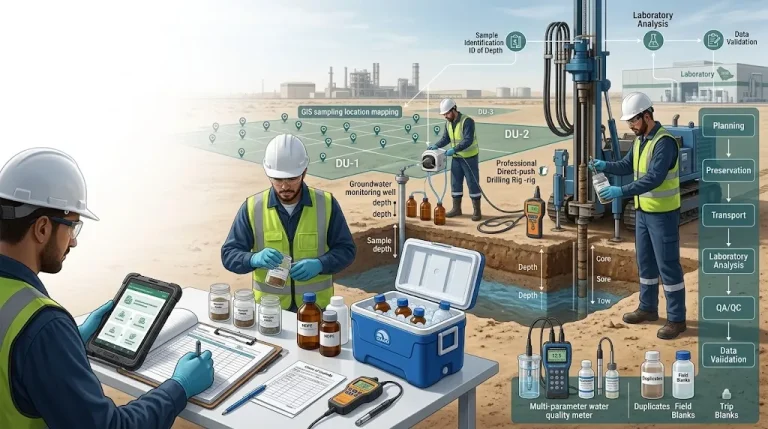
Before interpreting BOD, COD, TSS, or TDS, ask: Is the sample from the wastewater entering the treatment plant or leaving it? Is it a grab sample or a composite sample? And was it collected at a time representing normal operation?
A composite sample may reflect a time average according to the collection plan, while a grab sample represents the condition at a specific point and time. The two results cannot be compared as if they represent the same thing without clarification. Furthermore, wastewater results must be linked to production status, flow, cleaning and maintenance work, and any unusual operational conditions.
Why is there no single limit that suits all wastewater in Saudi Arabia?
It is incorrect to use a single general number as the "Saudi limit" for BOD, COD, TSS, or TDS across all facilities. Comparison depends on the type of wastewater, the disposal destination, the receiving medium, the nature of the activity, the permit conditions, and the applicable requirements for the case.
Therefore, do not settle for comparing the number to a circulated table. Review the correct permit condition, technical or regulatory reference, and verify that the parameter, unit of measurement, sample type, and monitoring point match what that reference requires.
Environmental Officer Checklist for Analysis Receipt
- Are the sample number, sampling point, date, and type clear and consistent with the field log?
- Was the sample a Grab or Composite sample? Does it represent the required operating conditions?
- Was the status of production, flow, and cleaning or maintenance activities recorded at the time of sampling?
- Are the units of measurement, analytical method, and reporting limits clear?
- Are there any quality remarks or codes in the lab report that require interpretation?
- How have BOD, COD, TSS, and TDS changed from the baseline?
- Has the BOD/COD ratio changed?
- Is there a change in the daily load, rather than just the concentration?
- What is the next step: follow-up, data verification, source investigation, or corrective action?
Frequently Asked Questions
Why is COD usually higher than BOD?
Because COD responds to a wider range of chemically oxidizable substances, including materials that may not be fully biodegradable during the BOD test period. However, the magnitude of the difference between them varies depending on the wastewater.
Can BOD be calculated from COD?
There is no fixed formula applicable to all industries. A site-specific correlation can be developed if reliable, concurrent data and an understanding of the water's nature are available, but it is incorrect to assume a general ratio.
Does high BOD mean that the treatment plant has failed?
Not necessarily. One must first determine if the sample is from the inlet or outlet, and review the flow, production, operating conditions, sample point and timing, and the performance of the treatment units.
Is TDS the same as salinity?
Not exactly. There is a strong relationship between them due to the contribution of dissolved salts, but they are not the same measurement in all water types and analytical methods.
Are these four indicators sufficient to evaluate all wastewater?
No. Depending on the activity, source, and discharge destination, the program may require additional indicators such as pH, conductivity, oil and grease, nutrients, metals, hydrocarbons, or other specific compounds.
How does the Albuad Environmental Company assist in monitoring wastewater?
Help Environmental Monitoring Reporting Service Facilities in linking laboratory results to wastewater sources, sampling points, flow, operating conditions, and trends. Results can also be organized within a log for environmental reports and records that illustrates changes, actions, and follow-ups.
The advisory value focuses on reviewing and interpreting data and supporting the facility's decision-making; while analysis and monitoring tasks are carried out within the scope of requirements and qualifications applicable to the service provider.
Conclusion
The four indicators are summarized as follows: BOD for biodegradable load, COD for chemically oxidizable load, TSS for suspended solids, and TDS for dissolved solids. However, professional management begins after the definitions: What is the sample point? What is the flow? What are the operating conditions? How have the indicators changed? And what is the daily load? With this reading, wastewater results turn into a tool for improving treatment, detecting deviations early, and supporting compliance.
Do you need to review wastewater results or build an appropriate monitoring program for your facility? Contact the Albuad Environmental Company team via WhatsApp to discuss the scope of work.
The content was reviewed by a team of environmental experts.
Environmental content at Albuad Environmental Company is prepared and reviewed by a team of specialists in environmental studies, environmental impact assessment, environmental compliance, and environmental monitoring.
Meet the expert team